

What is share dilution?
> Quick answer: Share dilution is the fall in an existing shareholder’s ownership percentage when a company issues new shares. You keep the same number of shares, but the total has grown, so each one represents a smaller slice of the company.
Dilution is also called equity dilution or stock dilution. The meaning is the same in a listed company or a private one. What differs is how often it happens and how visible it is. In listed stocks you might notice it in earnings per share or the share price. In a private company, you usually see it when the next funding round closes.
Share dilution by example: the pizza and the cap table
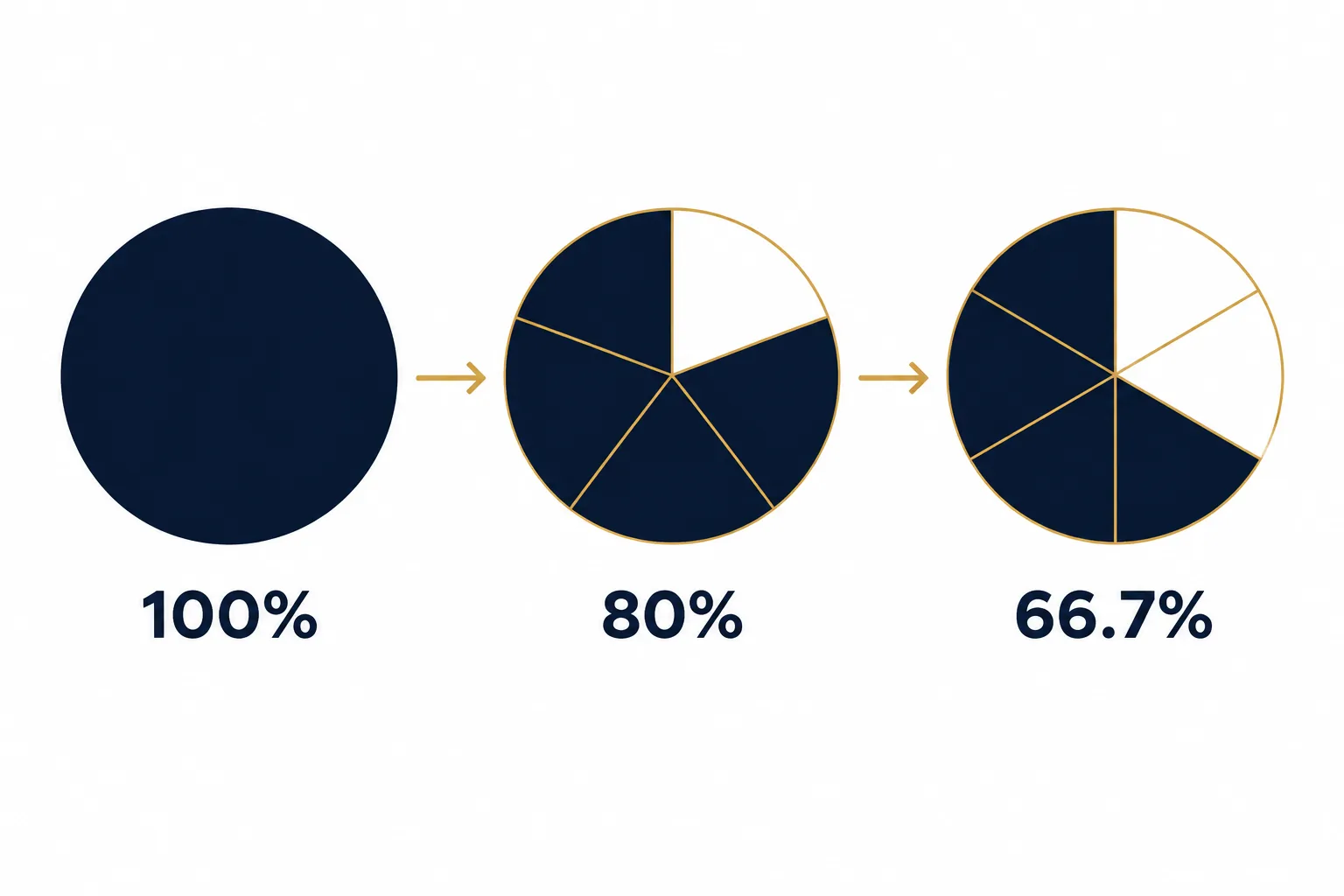
Think of a company as a pizza. Issuing new shares does not take your slices away. It cuts the pizza into more slices, so yours make up a smaller part of the whole.
Here is the same idea on a simple capitalisation table (cap table):
| Stage | Founder | Investor A | Investor B | Total shares |
|---|---|---|---|---|
| Start | 100 (100%) | 100 | ||
| Round 1: 25 new shares | 100 (80%) | 25 (20%) | 125 | |
| Round 2: 25 new shares | 100 (66.7%) | 25 (16.7%) | 25 (16.7%) | 150 |
The founder never sold a share, yet their stake fell from 100% to about 66.7%. Investor A was diluted too, from 20% to about 16.7%.
Percentage is only half the story. A smaller slice of a larger, better-funded company can be worth more than a bigger slice of a business that stalled for lack of capital.
Why companies issue new shares
Raising growth capital
Funding rounds (seed, Series A and later) are the most common cause of dilution in private companies. The new money typically pays for hiring, product development, new markets or acquisitions. Early-stage businesses rarely fund themselves from profits, so selling equity is often the main route to growth.
Employee share options and incentive pools
Companies set aside an option pool to attract and keep good people. When staff exercise their options, new shares are created and everyone else’s percentage falls. Pools are often created or topped up around a funding round, and depending on how the deal is structured, existing shareholders can end up carrying most of that dilution.
Convertible instruments, warrants and acquisitions
Some funding arrives now and turns into shares later. Convertible loan notes, warrants and convertible preference shares all add to the share count when they convert or are exercised.
In the UK, early-stage companies often use advance subscription agreements (ASAs), where investors pay upfront and receive shares at a future round. An ASA can qualify for SEIS if it meets criteria set by HMRC, which is one reason founders use them.
Paying for an acquisition with shares rather than cash also dilutes existing holders. In listed stocks, the familiar version is a secondary offering, where a public company sells additional shares after its IPO.
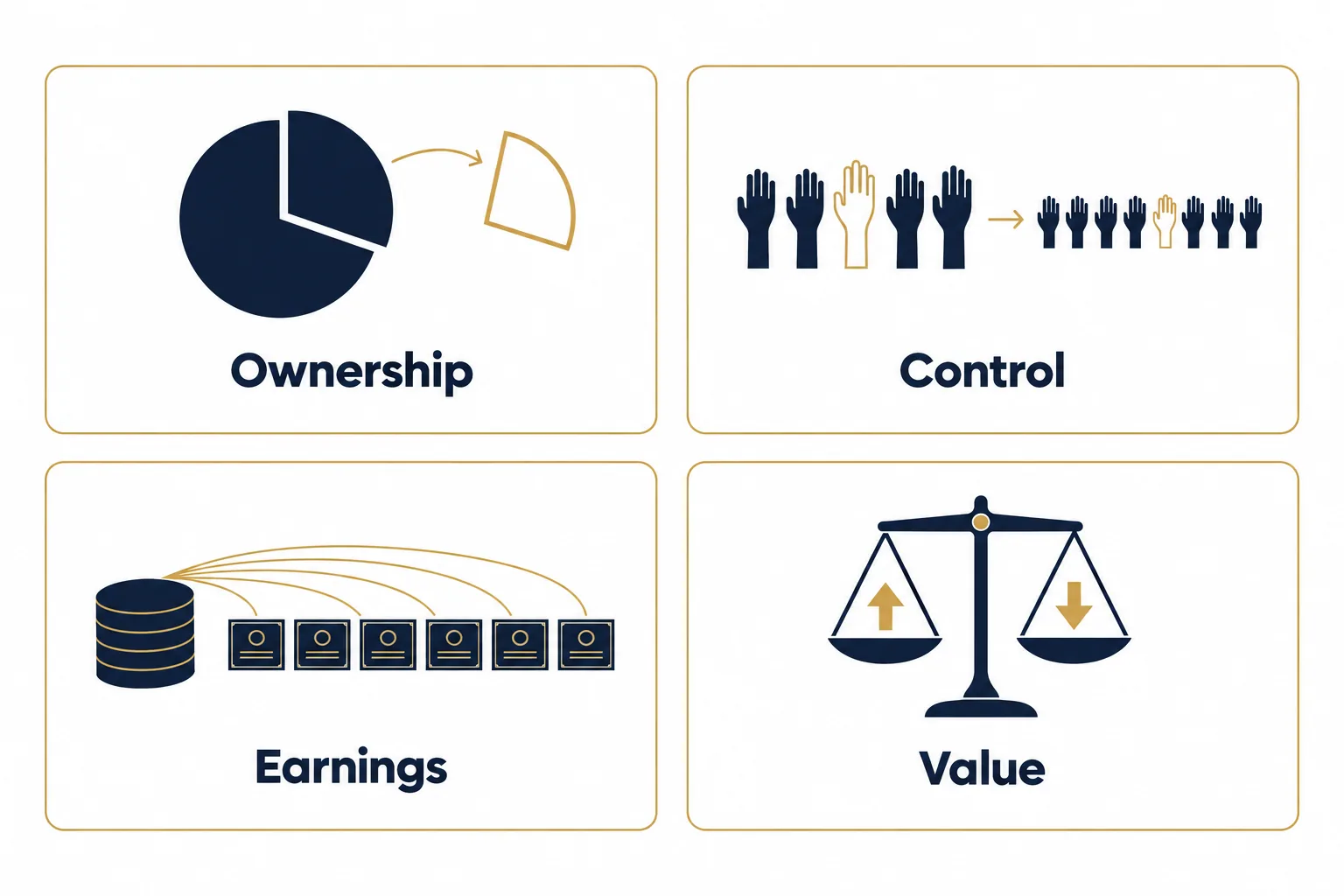
The four types of dilution investors should understand
Ownership dilution.
Your percentage stake shrinks. This matters most at exit, because sale proceeds are divided across the share count (subject to any preference terms).
Control dilution.
Your voting power falls. For a private company investor, this can mean losing the ability to block a decision, or dropping below thresholds set in the articles.
Earnings dilution.
Profit is spread across more shares, so earnings per share (EPS) falls. If a company earns £300,000 on 100 shares, EPS is £3,000. On 150 shares, it is £2,000.
Listed companies report diluted EPS for this reason: in a typical SEC earnings-per-share filing, the basic weighted average share count is increased by the dilutive effect of stock options, restricted stock and similar instruments.
Value dilution.
Whether each share is worth more or less after the issue depends on the price paid for the new shares compared with the company’s value. This is the type that decides whether dilution actually costs you money.
Fully diluted shares: the number that actually matters
Issued shares are the ones that exist today. The fully diluted share count adds every share that could exist: unexercised options, warrants and convertibles.
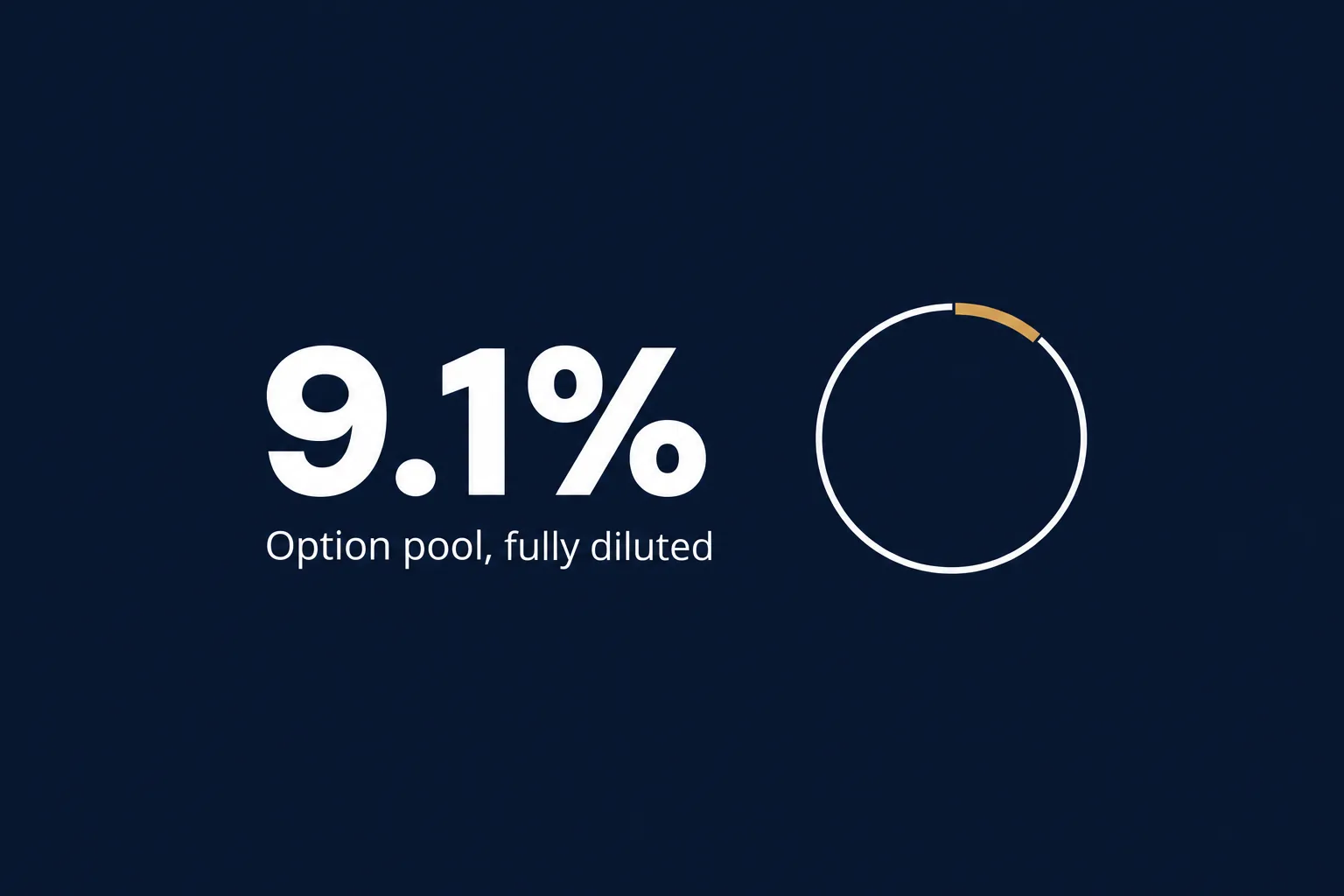
Suppose a company has 150 issued shares plus a 15-share option pool. On a fully diluted basis there are 165 shares. Investor A’s 25 shares look like 16.7% of the issued capital but are about 15.2% fully diluted.
Here is the same cap table on both bases:
| Shareholder | Shares | % of issued (150) | % fully diluted (165) |
|---|---|---|---|
| Founder | 100 | 66.7% | 60.6% |
| Investor A | 25 | 16.7% | 15.2% |
| Investor B | 25 | 16.7% | 15.2% |
| Option pool (unissued) | 15 | – | 9.1% |
| Total | 150 issued / 165 diluted | 100% | 100% |
Percentages are rounded, so the last column sums to 100.1%.
The pool takes 9.1% before anyone has exercised an option. Every existing holder is diluted by it.
That gap flows straight into what your stake is worth. Valuing a holding means moving from enterprise value to equity value, then dividing by the fully diluted share count. Our guide on how to value a private company before investing walks through each step.
Is dilution good or bad?
Neither, by default. It depends on the price of the new shares and what the money achieves.
Good dilution happens when capital is raised at a higher valuation (an up round) and used to grow the business.
Bad dilution comes from down rounds, shares issued cheaply, or repeated raises with little growth to show for them.
Take the founder above, holding 100 of 125 shares, and compare two versions of Round 2, each issuing 25 new shares:
| Up round | Down round | |
|---|---|---|
| Pre-money valuation | £3,000,000 | £750,000 |
| Price per share | £24,000 | £6,000 |
| Founder’s stake after | 66.7% | 66.7% |
| Founder’s stake value | £2,400,000 | £600,000 |
Same percentage, very different outcomes. The up round left the founder better off. The down round cut their percentage and their value.
What happens when your shares get diluted?
You keep the same number of shares. Your percentage falls, your voting influence falls with it, and the value of each share may rise or fall depending on the round price.
In listed stocks, the market may react straight away through EPS and the share price. In private companies, the effect usually shows up at the next valuation or at exit.
Follow Investor A through to a sale. They paid £250,000 for 25 shares in Round 1. After Round 2 they hold about 16.7% of 150 shares. If the company is later sold for £6,000,000, each share is worth £40,000 and their 25 shares come to £1,000,000, before any preference terms or fees. Dilution cut their percentage, but the capital raised helped build a more valuable business.
Share dilution when investing in private companies
If you are exploring how to invest in private companies, dilution deserves more attention than it usually gets. Early-stage and growth businesses often need several funding rounds before an exit, and each round can dilute earlier investors. A stake bought at seed may be a fraction of its original size by the time the company sells or lists.
The rules on individuals investing in private companies vary by country, and many opportunities are only open to investors who qualify as high net worth or sophisticated. Whatever route you take, dilution sits alongside illiquidity as a risk rarely spelled out on a pitch deck. We cover both in our guide to the risks of investing in unlisted UK companies.
Dilution at the pre-IPO stage
Later-stage investing does not remove dilution. Companies may issue new shares at listing, preference shares often convert to ordinary shares, and option holders may exercise around the IPO. Add lock-up periods and it is clear why pre-IPO investing carries risks that are easy to underestimate.
How to protect yourself from share dilution
In a growing company you rarely avoid dilution entirely. You can manage it.
Pre-emption rights.
These give you the right to buy new shares in proportion to your existing holding before outsiders can. In the UK, section 561 of the Companies Act 2006 requires a company allotting new equity securities for cash to first offer existing ordinary shareholders a proportion as nearly as practicable equal to their current holding.
These rights are not guaranteed: the Act allows them to be disapplied by the articles or by a special resolution of shareholders.
Anti-dilution provisions.
These protect investors if a later round is priced lower. A full ratchet resets the investor’s price to the new, lower issue price.
A weighted average provision is gentler: the weighted average anti-dilution formula adjusts the conversion price using both the money raised and the number of new shares issued. Lead or institutional investors negotiate these terms more often than smaller individual holders.
Share Dilution is generally calculated by dividing the existing shares of a shareholder by the sum of existing shares and new shares. The result is …Read on LinkedIn ↗
Here is how each protection plays out in the down round from earlier. Investor A paid £10,000 per share in Round 1. Round 2 issues 25 new shares at £6,000.
| No protection | Weighted average | Full ratchet | |
|---|---|---|---|
| Investor A’s adjusted price | £10,000 | £9,333 | £6,000 |
| Investor A’s shares (as converted) | 25 | 26.8 | 41.7 |
| Total shares | 150 | 151.8 | 166.7 |
| Investor A’s stake | 16.7% | 17.6% | 25.0% |
| Investor B’s stake | 16.7% | 16.5% | 15.0% |
| Founder’s stake | 66.7% | 65.9% | 60.0% |
Investor A’s extra shares come out of everyone else’s stake. The founder pays most of the bill, and the full ratchet costs them 6.7 percentage points.
Ask for the full picture.
Request the current and fully diluted cap table, not just the issued share count. Also ask for the size of the option pool, any convertibles or warrants that haven’t converted yet, and how much more funding the company expects to need before an exit. Those answers show how much dilution is already built in and how much is likely to come.
Read the documents.
The articles of association and shareholder agreement set out how new shares can be issued and what rights you hold. Check whether you have pre-emption rights, whether they can be disapplied, and what vote is needed to issue new shares. Also look for any anti-dilution terms and whether preference shares rank ahead of yours at exit.
Keep reserves.
If holding your percentage matters, set aside capital to follow on in later rounds. Pre-emption rights only help if you can afford to use them. A common rule of thumb is to hold back extra money for follow-on investments, but the right amount depends on the company, so don’t treat any single figure as a target.
Questions to ask before you invest
- How much more capital will the business need before an exit?
- What is the fully diluted share count today?
- Do I get pre-emption or anti-dilution rights?
- What happens to my stake in a down round?
- Are there preference shares that rank ahead of mine at exit?
At Beaufort Society, we want members asking exactly these questions, and we expect to answer them plainly. We do not sell, and we do not tell anyone what to do with their money. We share information on the businesses we work with, explain how the terms work, and leave the decision with you. If you want to understand private markets better and see opportunities you will not find on typical angel investing sites, the club is free to join.
Frequently asked questions
What is share dilution in stocks?
Is dilution good or bad for a stock?
What is share dilution by example?
How do you avoid share dilution?
Does dilution mean I lose money?
Important information
Investing in private companies puts your capital at risk. Investments can be illiquid, you may not be able to sell when you want to, and returns are not guaranteed. This article is for educational purposes only and is not financial advice. Consider seeking independent professional advice before investing.