
“Seis” Has Several Meanings: The Quick Disambiguation
| Meaning | Category | What it is |
|---|---|---|
| Seis (six) | Spanish and Portuguese | The cardinal number six, an ordinary word, not an abbreviation of anything |
| Seed Enterprise Investment Scheme | UK finance | A government-backed set of tax reliefs for individuals who invest in very young companies |
| Special Education Information System | US education | A records platform school districts use to manage individualised education programme paperwork |
| Seismic Experiment for Interior Structure | Space science | A seismometer built to study a planet’s interior by listening to how it shakes |
| Seis (stop) | Finnish | An interjection meaning stop or halt |
What Is SEIS (Seed Enterprise Investment Scheme)?
The Seed Enterprise Investment Scheme is a UK government initiative giving individual investors a set of tax reliefs when they subscribe for new shares in qualifying seed-stage companies.
The logic is straightforward. Companies at the very start of their life, often pre-revenue with a founding team and a prototype, are the hardest of all to fund. The failure rate is high, there is no trading history to underwrite, and conventional lenders will not touch them. Left alone, the market underfunds that stage. SEIS shifts part of the risk from the investor onto the Exchequer, so backing an unproven company becomes a rational decision for a wider group of people.
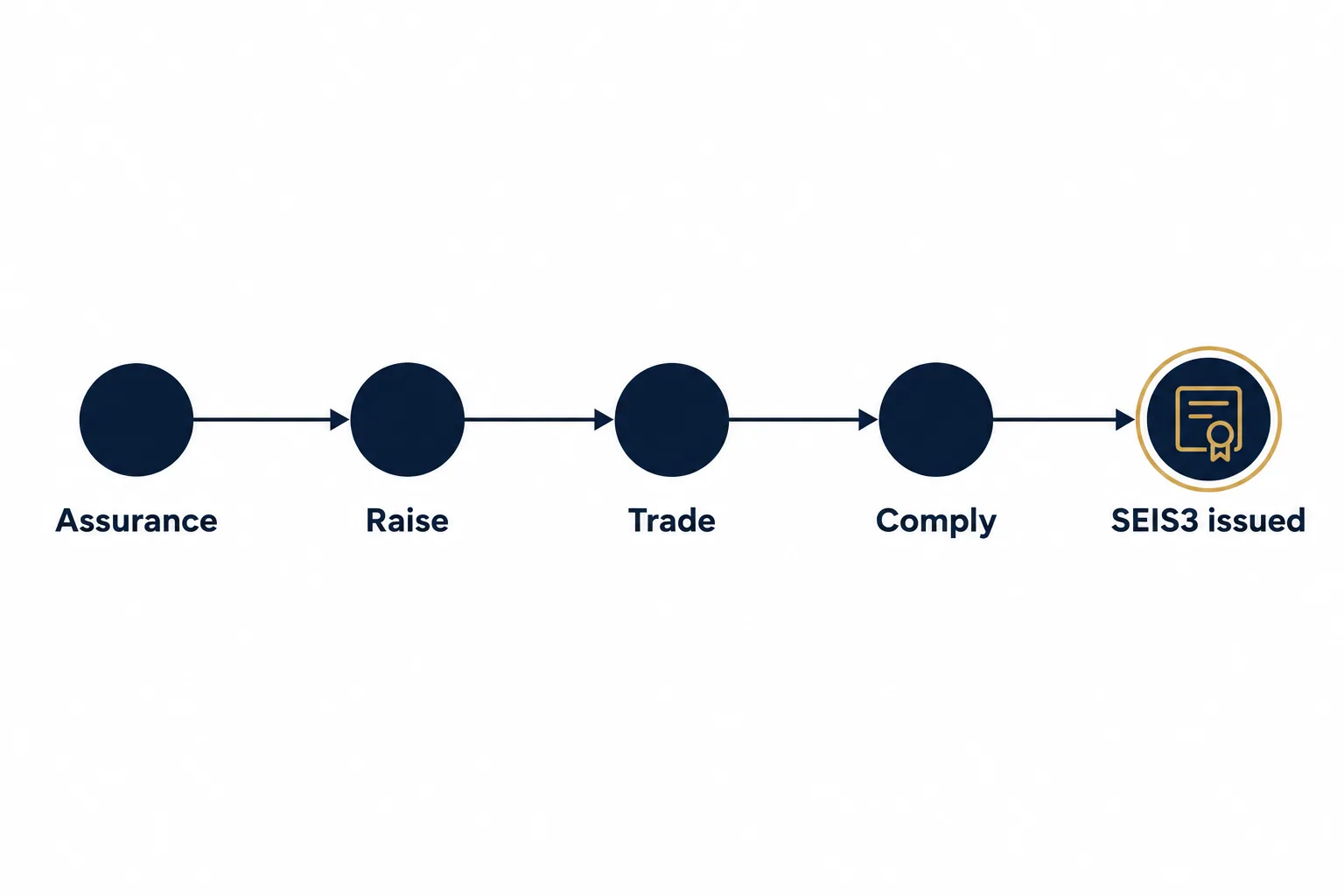
HMRC administers the scheme. In practice a company seeks advance assurance from HMRC that its proposed share issue looks likely to qualify, raises the money, trades for a minimum qualifying period, then submits a compliance statement. Once HMRC authorises it, the company issues SEIS3 certificates to its investors, and those certificates are what an investor uses to claim relief.
SEIS sits deliberately below the Enterprise Investment Scheme on the ladder. It is the first rung, not a replacement for the rest of the private markets.
What Do SEIS and EIS Stand For, and How Do They Differ?
SEIS is the Seed Enterprise Investment Scheme. EIS is the Enterprise Investment Scheme. EIS came first. SEIS was introduced in 2012 to complement it, because a category of company existed that was too young, too small and too speculative to attract EIS money at all.
The differences run along predictable lines:
Related readingSEIS vs EIS: Limits, Relief Rates and Which FitsRead the guide →| Dimension | SEIS | EIS |
|---|---|---|
| Stage targeted | Seed and pre-seed | Early growth and scale-up |
| Company trading age limit | Under 3 years | Up to 7 years from first sale (10 for knowledge-intensive) |
| Gross asset ceiling | £350,000 | £30 million before the shares are issued, £35 million after |
| Employee cap | Fewer than 25 | Fewer than 250 (500 for knowledge-intensive) |
| Total the company can raise | £250,000 lifetime | £10 million a year, £24 million lifetime (£20 million/£40 million for knowledge-intensive) |
| Investor annual subscription cap | £200,000 | £1 million (£2 million including knowledge-intensive companies) |
| Income tax relief rate | 50% | 30% |
The precise thresholds, rates and caps in each column are set by legislation and have been revised more than once since launch, so we do not print figures here that will go stale. Check the current numbers in HMRC’s own guidance on GOV.UK, or with a qualified tax adviser, before you plan around them. Plenty of articles still quote limits that have since been superseded.
One sequencing point matters more than most people realise: a company generally needs to use its SEIS allowance before it moves on to EIS rounds. Get that order wrong and relief can be lost for everyone involved.
Venture Capital Trusts are a third tax-advantaged route, but they are pooled and listed vehicles, structurally quite different from subscribing directly for shares in one company.
What Is the SEIS Tax Relief?
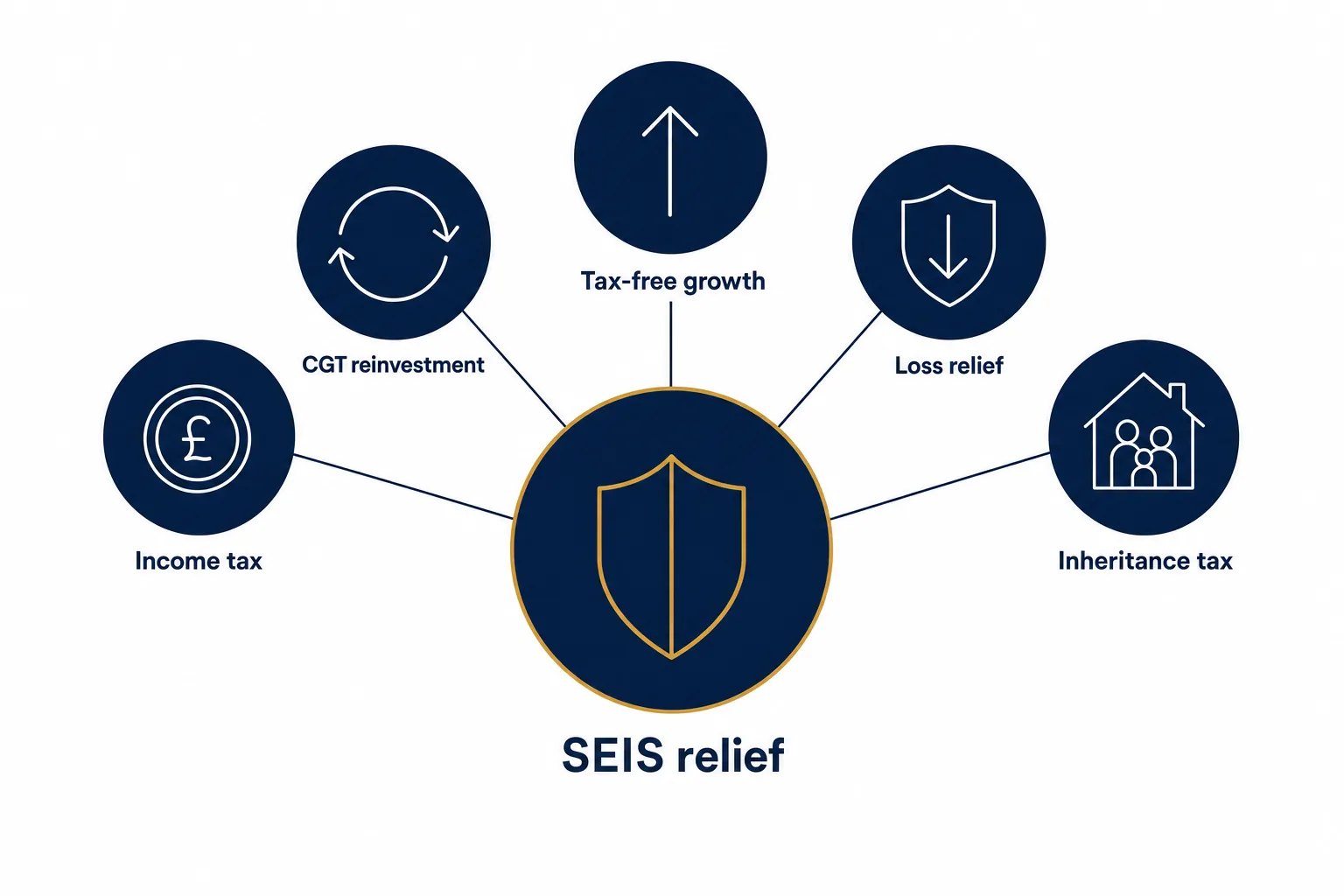
People talk about “the SEIS tax relief” as though it were one thing. It is a bundle, and the bundle is the point.
| Relief | What it does | Key condition |
|---|---|---|
| Income tax relief | 50% of the amount subscribed, set against your income tax liability for the year | Can be carried back to the previous tax year |
| CGT reinvestment relief | 50% of a reinvested chargeable gain can be exempted | Gain must be reinvested into qualifying SEIS shares |
| CGT disposal exemption | Growth on the shares is tax-free on sale | Shares held at least three years |
| Loss relief | Loss, net of income tax relief claimed, can be set against income or gains | Requires evidence of negligible value or formal liquidation |
| Inheritance tax treatment | Shares may attract business relief | Ownership conditions must be met at the time |
Stacked together, these reliefs mean the effective net cost of a SEIS subscription to a UK taxpayer is meaningfully lower than the cash amount, and the worst case after loss relief is softer than a total write-off. That is the honest description. What it is not is a guarantee.
Every relief depends on your personal tax position, on you holding the shares for the minimum period, and on the company keeping its qualifying status throughout.
Tax rules change, and reliefs can be withdrawn retrospectively if conditions are breached.
Which Companies Qualify for SEIS?
A company generally needs to satisfy all of the following when the shares are issued:
- It is carrying on a new qualifying trade, and has been doing so for less than the permitted period.
- Its gross assets sit below the ceiling set for the scheme.
- It employs fewer than the maximum permitted number of full-time equivalent staff.
- It has not exceeded the lifetime cap on what a single company can raise under SEIS.
- It has a permanent establishment in the UK.
- It is not controlled by another company.
Certain trades are excluded outright, on the basis that they are asset-backed or low-risk enough not to need the incentive. Property development, dealing in land or shares, banking and insurance, leasing, legal and accountancy services, and subsidised energy generation are among them. If a proposition sounds like a property play wrapped in a technology label, that is exactly what the exclusions are designed to catch.
Who Can Invest in SEIS, and What Are the Limits?
SEIS is used by individual UK taxpayers with an income tax liability to offset. In practice that skews towards high net worth and self-certified sophisticated investors, alongside founders’ own networks and angel syndicates.
The conditions on the investor side:
- An annual cap applies to how much you can subscribe under SEIS across all companies in a tax year.
- The shares must be new, full-risk ordinary shares, paid up in full in cash. Loans converting into equity do not qualify.
- Connection rules apply. Employees, and investors holding more than a set percentage of the company, are generally excluded from relief. Directors are treated differently under SEIS than under EIS, which catches people out.
- No reciprocal arrangements and no pre-arranged exit. The risk has to be real.
- A minimum holding period of three years applies, running from the share issue or the start of trade, whichever is later. Sell early, or let the company lose its status, and relief can be clawed back.
If you are not a UK taxpayer, the position is simple: no UK income tax liability generally means no income tax relief to claim. That matters for international members, and it is worth saying plainly rather than burying it. A non-resident investor can still back a British company on its merits. They just should not build the case on reliefs they cannot use.
Why SEIS Exists: A Short History
SEIS arrived after EIS, when seed-stage funding in the UK had thinned out badly. The gap it was built to close was specific: companies with a team and an idea but nothing an EIS investor could yet underwrite. Since launch its thresholds have been widened and its original sunset provision removed, which tells you something about the policy direction. Early-stage capital remains something successive governments have chosen to subsidise.
The Risks Nobody Should Skim Past
Seed-stage companies fail often. That is not a caveat bolted onto a sales pitch; it is the base rate, and it is precisely why the reliefs exist. Tax relief reduces a loss. It never removes one.
Illiquidity. There is no meaningful secondary market for unlisted seed shares. Exits take years, often longer than anyone forecasts, and frequently do not happen at all.
Dilution. Your stake will almost certainly shrink across subsequent funding rounds. A good outcome usually still involves being diluted repeatedly.
Valuation risk. At seed stage there is no revenue history to anchor a price. Valuations are negotiated, not calculated. Paying too much at entry is one of the quietest ways to lose money in this asset class.
Relief withdrawal. If the company breaches its conditions, or you breach yours, HMRC can withdraw relief already claimed.
Concentration. SEIS belongs as a small slice of a broader portfolio, spread across several companies and several vintages, never as the core of one.
One thing most guides skip: what actually happens when a company fails. You will typically need evidence of the shares becoming of negligible value, or of a formal liquidation, before loss relief can be claimed. That takes time and paperwork, and it is worth knowing in advance rather than discovering it during a wind-down.
How a SEIS Investment Works, Step by Step
Most pages explain the rules. Far fewer explain the sequence.
- Advance assurance. The company applies to HMRC for a view on whether the proposed share issue is likely to qualify. Not mandatory, but experienced investors expect to see it.
- Investor review. You read the information memorandum, the financial model, the cap table and the founder’s track record, and form your own view.
- Subscription and share issue. You subscribe, funds are paid in full in cash, shares are issued. Keep the share certificate.
- Qualifying trading period. The company must trade for a minimum period before it can move to the next step.
- Compliance statement. The company submits its statement to HMRC confirming conditions have been met.
- SEIS3 certificates. Once HMRC authorises it, the company issues certificates to investors.
- Claim. You claim through Self Assessment, or by amending a prior year’s return if you are carrying the relief back.
Expect months to pass between writing a cheque and holding a SEIS3. Plan your tax year around that lag rather than assuming relief lands immediately.
Due Diligence Questions Worth Asking Before You Subscribe
- Has advance assurance been granted, and does it cover the exact share class being offered?
- How much of the company’s SEIS allowance has already been used?
- What is the founder’s track record, and how much of their own capital is in?
- Which specific milestone does this round’s runway actually reach?
- Who else is on the cap table, and on what terms? Are there preferences ahead of you?
- What is the realistic exit path, and over what horizon?
Informed questions beat sales pressure every time. If questions like these produce irritation rather than an answer, that itself is information.
How SEIS Fits Into Investing in Private Companies
SEIS is one route into private markets, and it sits at the earliest, highest-risk end. If you are working out how to invest in private equity in the UK, or simply asking whether you can invest in private companies at all as an individual, several routes exist and they suit different people:
- Direct SEIS and EIS subscriptions into single companies
- Angel syndicates investing collectively
- Managed EIS portfolios, where a manager selects and diversifies for you
- Later-stage private equity funds, with higher minimums and longer lock-ups
- Private investor clubs offering curated direct opportunities
Worth holding onto: not every good private company is SEIS-qualifying. Screening only for the tax wrapper narrows your field artificially and can push you towards younger, riskier propositions than you intended. Diversification across stage, sector and vintage does more for outcomes than the relief available on any single deal.
A practical note on timing. Deal flow is seasonal, and August and December are consistently the quietest months in this market. Good months to read, ask questions and build your framework, rather than to rush a subscription because a deadline is looming.
Where Beaufort Society Fits
Beaufort Society is a private equity firm with an investor club attached to it, and the club is free to join. Our members are high net worth and self-certified sophisticated investors, based worldwide, who want to understand private markets properly before they commit to anything.
We do not sell. Members receive context on what we are seeing, why a company is raising and what the risks look like, then they decide. A good deal of what we introduce is not visible on open angel platforms. The club is deliberately intimate, and the relationships in it are the reason it works.
We are equally open about commercials. Beaufort earns an introducer fee paid by the company raising the funds when a member invests. Members are not charged for access.
Beaufort does not provide tax or financial advice, and nothing here is a recommendation to invest. SEIS reliefs depend on your own circumstances and on current legislation, so confirm your position with a qualified adviser and against HMRC’s published guidance.
If you would like to see private opportunities as they come up, with the context to assess them, you are welcome to join the club and start receiving our briefings.