
VCT: the short answer
VCT is an acronym with several unrelated meanings, and context decides which one applies. The five you are most likely to run into:
| Meaning | Category | What it is |
|---|---|---|
| Venture Capital Trust | Finance | A UK listed investment company that backs small, young businesses, with tax reliefs attached |
| VALORANT Champions Tour | Esports | The professional competitive circuit for the game VALORANT |
| Vinyl Composition Tile | Flooring | A hard-wearing commercial floor tile |
| Voluntary Counselling and Testing | Health | HIV testing with confidential counselling before and after the test |
| Variable Camshaft Timing | Automotive | Engine technology that adjusts valve timing |
Most of what follows covers the finance meaning, because that is the one people research before committing money.
The non-finance meanings, briefly
VALORANT Champions Tour
Riot Games’ official professional circuit for VALORANT. Regional leagues feed into international events and a year-end world championship. The format has changed over the years, moving from open qualifiers to partnered leagues.
Flooring, healthcare and cars
Vinyl Composition Tile is a dense, low-cost floor tile used in schools, hospitals and retail units where durability matters more than appearance. Voluntary Counselling and Testing describes HIV testing services where a person chooses to be tested and receives private counselling either side of the result. Variable Camshaft Timing varies when an engine’s valves open and close to improve power and fuel efficiency, and that is the answer if you searched for what a VCT is on a car.
What a Venture Capital Trust is
A Venture Capital Trust is a UK investment company, listed on the London Stock Exchange, that pools money from individual investors and puts it into small trading companies, usually unquoted or quoted on AIM.
The structural point that matters: you buy shares in the trust, not in the businesses it backs. A fund manager selects the portfolio, monitors it and decides when to sell. You own a slice of a basket of early-stage companies rather than one company you picked yourself.
The UK government created the structure to push private capital towards higher-risk smaller companies that struggle to raise money from banks, and attached tax reliefs to compensate investors for that risk.
VCTs have been doing this since 1995, and have raised more than £12 billion for UK businesses since launch. The 2025/26 tax year alone brought in £918 million, the strongest year in three, as investors rushed to lock in the 30% relief rate before it dropped to 20%.
That is what separates a VCT from a conventional venture capital fund: VCTs are publicly listed, open to ordinary retail investors and governed by a specific set of HMRC rules.
VCT tax reliefs and the conditions attached
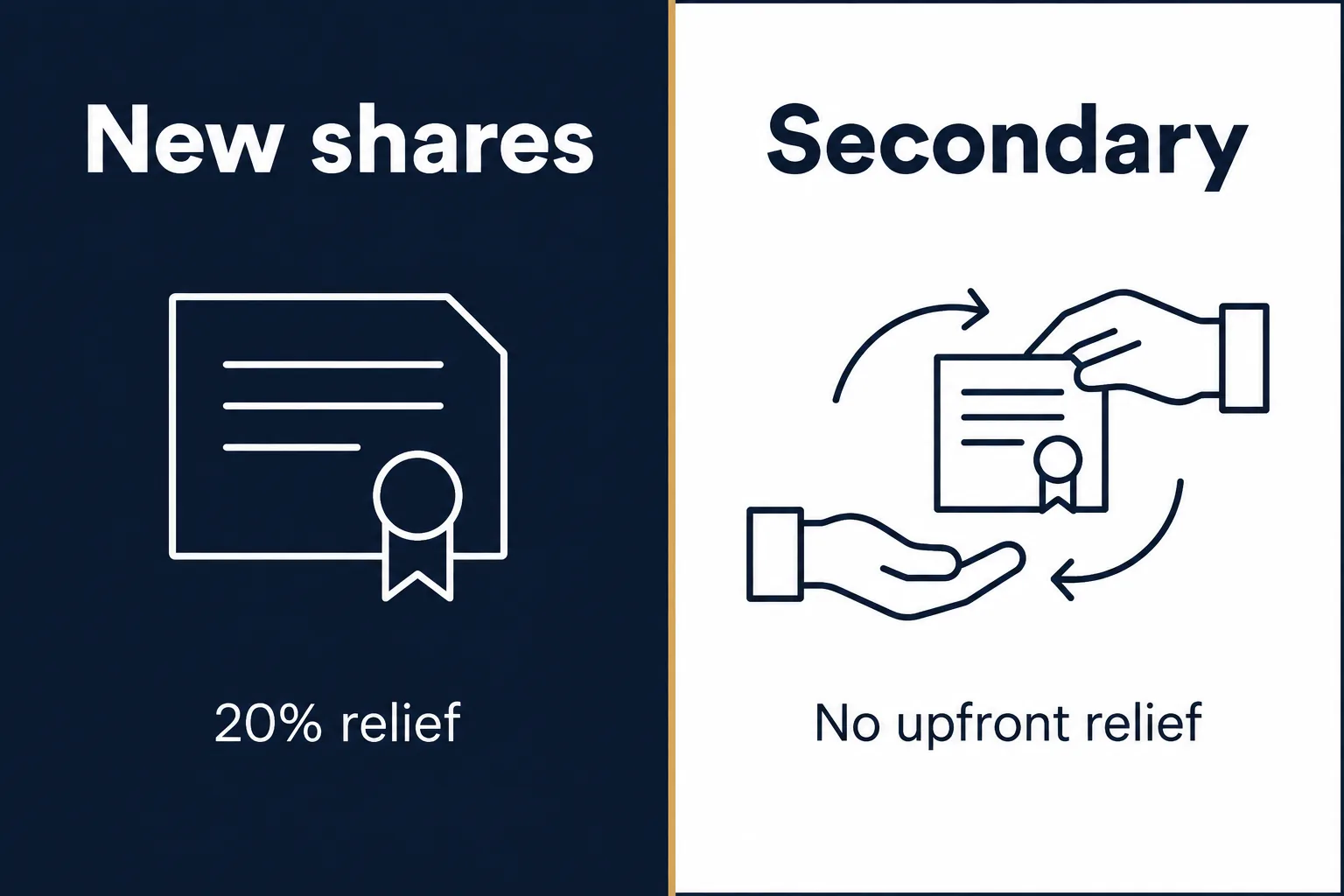
VCT tax treatment has three parts, and each carries conditions:
- Upfront income tax relief on subscriptions for newly issued VCT shares, currently 20% on up to £200,000 a year, cut from 30% on 6 April 2026, conditional on holding the shares for a minimum of five years.
- Tax-free dividends within that annual limit, which matters because most VCT returns arrive as dividends rather than share price growth.
- No capital gains tax on gains when the shares are eventually sold.
Three traps catch people out. Upfront relief applies only to new shares issued by the trust, not to shares bought second-hand on the market, although the dividend and capital gains treatment still applies to those. Relief cannot exceed the income tax you actually paid that year, so it reduces a bill rather than generating a windfall. And selling before the minimum holding period ends triggers clawback of the relief already claimed.
Rates, annual limits and holding periods are set by government and change at Budgets. Treat this as general information rather than tax advice, and check the current HMRC position with your own accountant or adviser before subscribing.
The rules a VCT has to follow
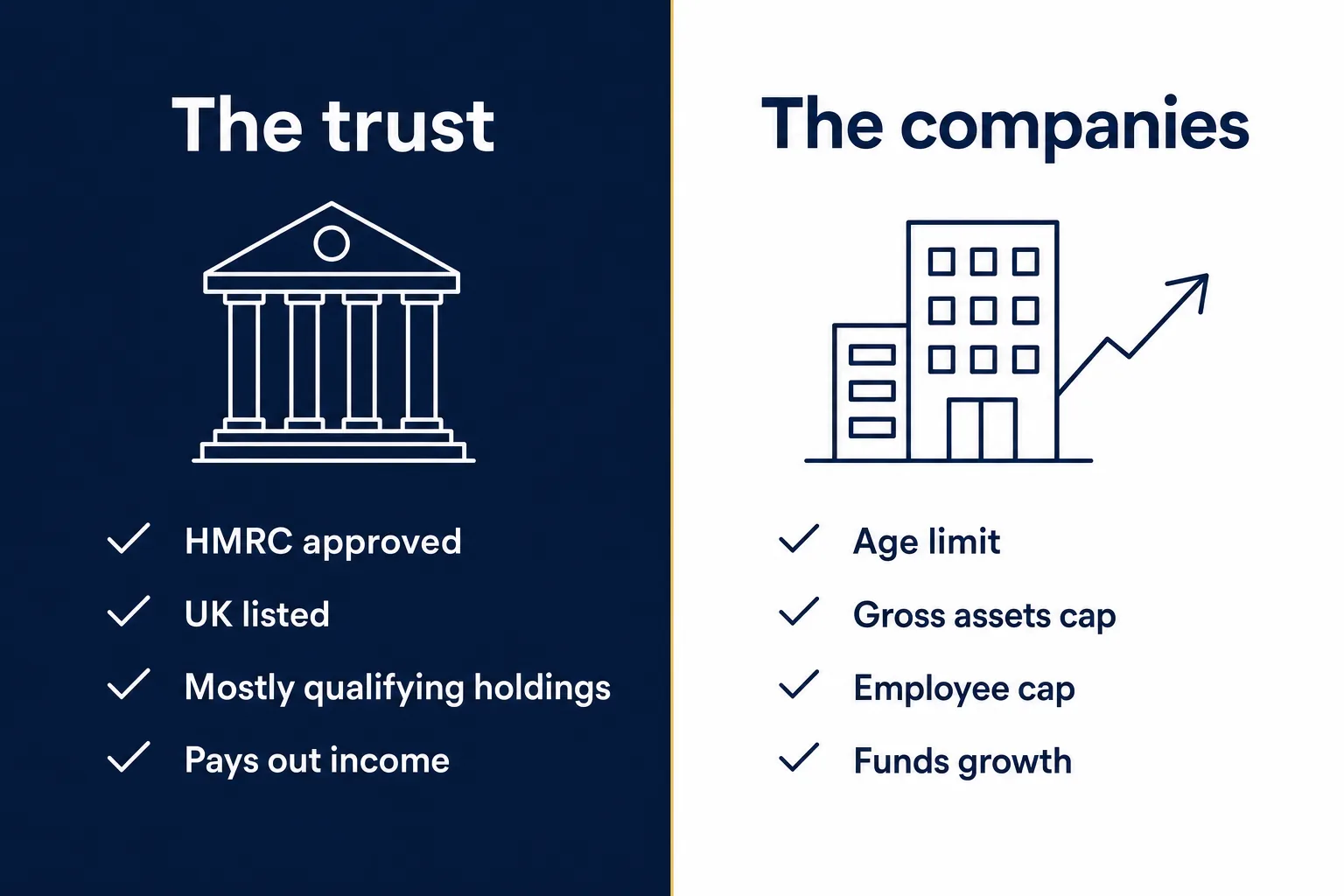
Most guides list the reliefs and skip the conditions that keep them in place.
A trust must be approved by HMRC and listed on a UK recognised stock exchange, which includes AIM as well as the main market. Several VCTs, including some of the largest, are AIM-quoted rather than main-market listed.
It must hold a minimum proportion of its investments in qualifying holdings, and it cannot put more than a set share of the fund into any single company. Its income must come largely from shares and securities, and it must distribute a defined proportion of that income to shareholders.
The companies receiving the money face their own tests on age, gross assets and employee numbers, and the funding must support growth rather than buy an existing business.
Since 6 April 2026, these limits have become considerably more generous. Qualifying companies can now have gross assets of up to £30 million immediately before shares are issued, up from £15 million, and must generally have fewer than 250 full-time equivalent employees. The limit remains fewer than 500 employees for knowledge-intensive companies.
Most companies can now raise up to £10 million in relevant investment in any 12-month period and £24 million over their lifetime, up from £5 million and £12 million respectively. Knowledge-intensive companies can raise up to £20 million annually and £40 million over their lifetime.
Worth knowing, because most of what’s currently published on this, including well-established reference sources, still states the old, smaller figures.
If a trust breaches these conditions it can lose VCT status, and shareholders can lose the tax treatment they were counting on.
How people buy into a VCT
Two routes. Subscribe to a new share offer while a trust is raising money, which is the only way to get the upfront income tax relief. Or buy existing shares through a broker on the secondary market, which gets you the dividend and capital gains treatment but not the upfront relief.
New offers tend to open in the autumn and close near the tax year end, so anyone using an annual allowance is working to a calendar. Before committing, check the initial charge, the annual management fee, any performance fee and the dealing costs of exiting. Be realistic about liquidity: VCT shares frequently trade below net asset value, and the trust’s own buyback programme is usually the practical exit rather than an open market of willing buyers.
What VCTs do not do well
Tax relief is not a return. It softens the entry price on a portfolio of small, illiquid companies, some of which will fail. Dividends depend on the manager realising investments, so they are neither guaranteed nor smooth.
A VCT is also a blind pool. You are backing a manager and a mandate, not a business you have researched. You see little of the individual deals and have no say in what gets funded. Returns arrive slowly across many years. The reliefs themselves sit with government and can be changed.
VCTs compared with investing in private companies directly
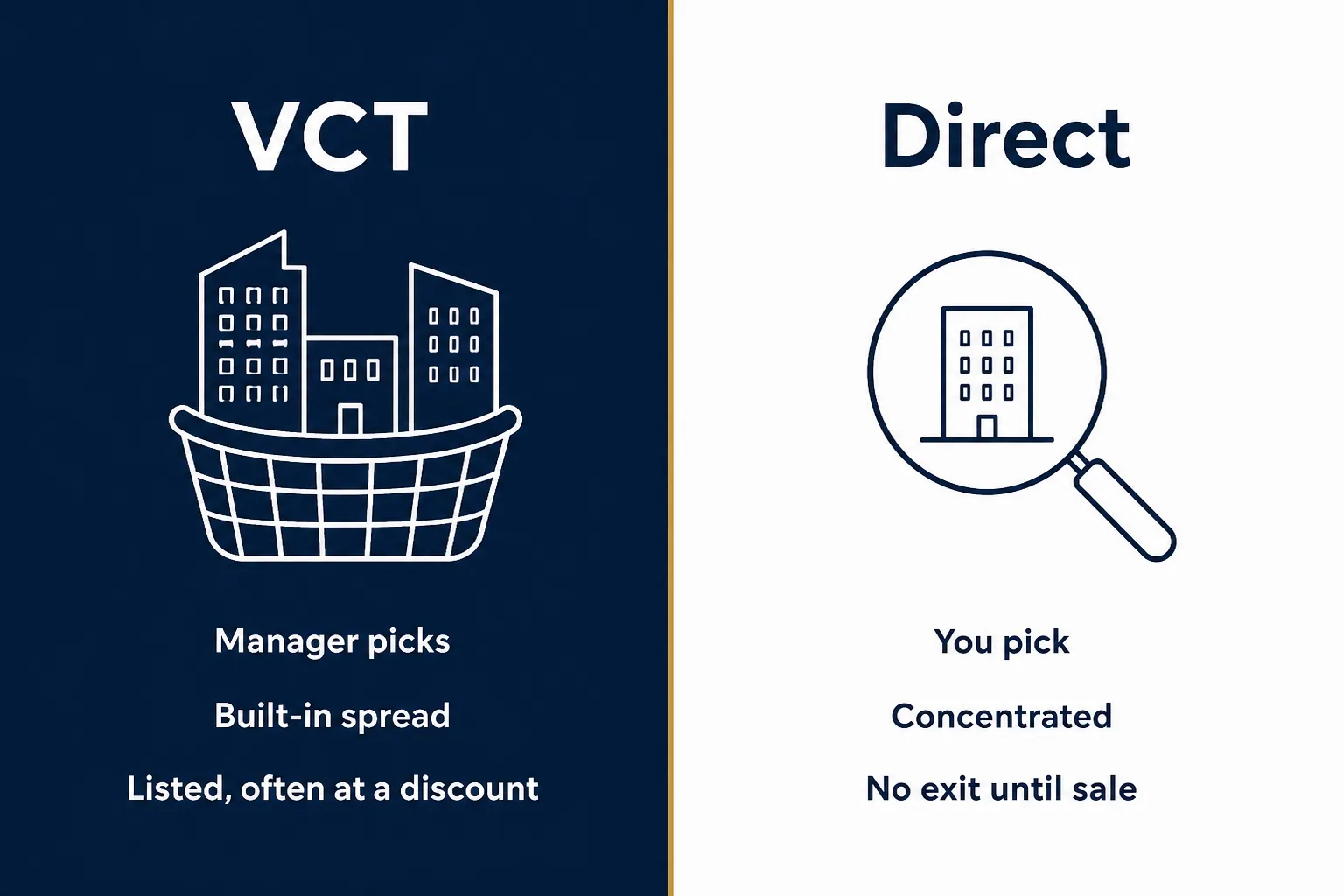
People researching how to invest in private equity in the UK usually end up weighing a VCT against direct investment, and against EIS and SEIS, the other UK schemes that carry their own reliefs and conditions.
Related readingEIS vs VCT: Key Differences for UK InvestorsRead the guide →| Venture Capital Trust | Direct private company investment | |
|---|---|---|
| Who picks the companies | The fund manager | You do, deal by deal |
| Information before committing | Prospectus and mandate | The specific business, its numbers, its founders |
| Diversification | Built in | Only if you build it |
| Liquidity | Listed, but often at a discount | None until a sale or exit |
| Tax | Its own HMRC regime | Depends on the deal and scheme |
Can you invest in private companies directly? Yes, if you qualify as a high net worth or self-certified sophisticated investor. The trade-off is concentration risk in exchange for knowing exactly what you own. Plenty of investors run both: a VCT for diversified exposure they never have to think about, and direct positions where they have conviction.
Where a private investment club fits
Beaufort Society sits on the direct side of that table. Members see individual private companies raising money, with the information to assess each one, rather than a pooled trust choosing on their behalf. Many of those opportunities never reach open angel platforms.
The club is free to join. Beaufort is paid an introducer fee by the company raising funds when a member invests, which is worth stating plainly rather than leaving it in the small print. Nobody is sold to. The work is education and market updates so members ask sharper questions and reach their own decisions, in a club small enough that every member is dealt with individually.
If you are weighing a private investment company route against a VCT, joining costs nothing and gives you something concrete to compare.