
Companies are staying private for much longer than they used to. A generation ago, a fast-growing business might list within a few years; today many wait a decade or more, and some never list at all. That means a large share of a company’s value creation now happens before ordinary investors can buy the stock on a public exchange. So the question is a fair one: if the growth is happening in private, is it worth trying to invest there, and can you actually get in? Here is a straight answer.
What “investing in private companies” actually means
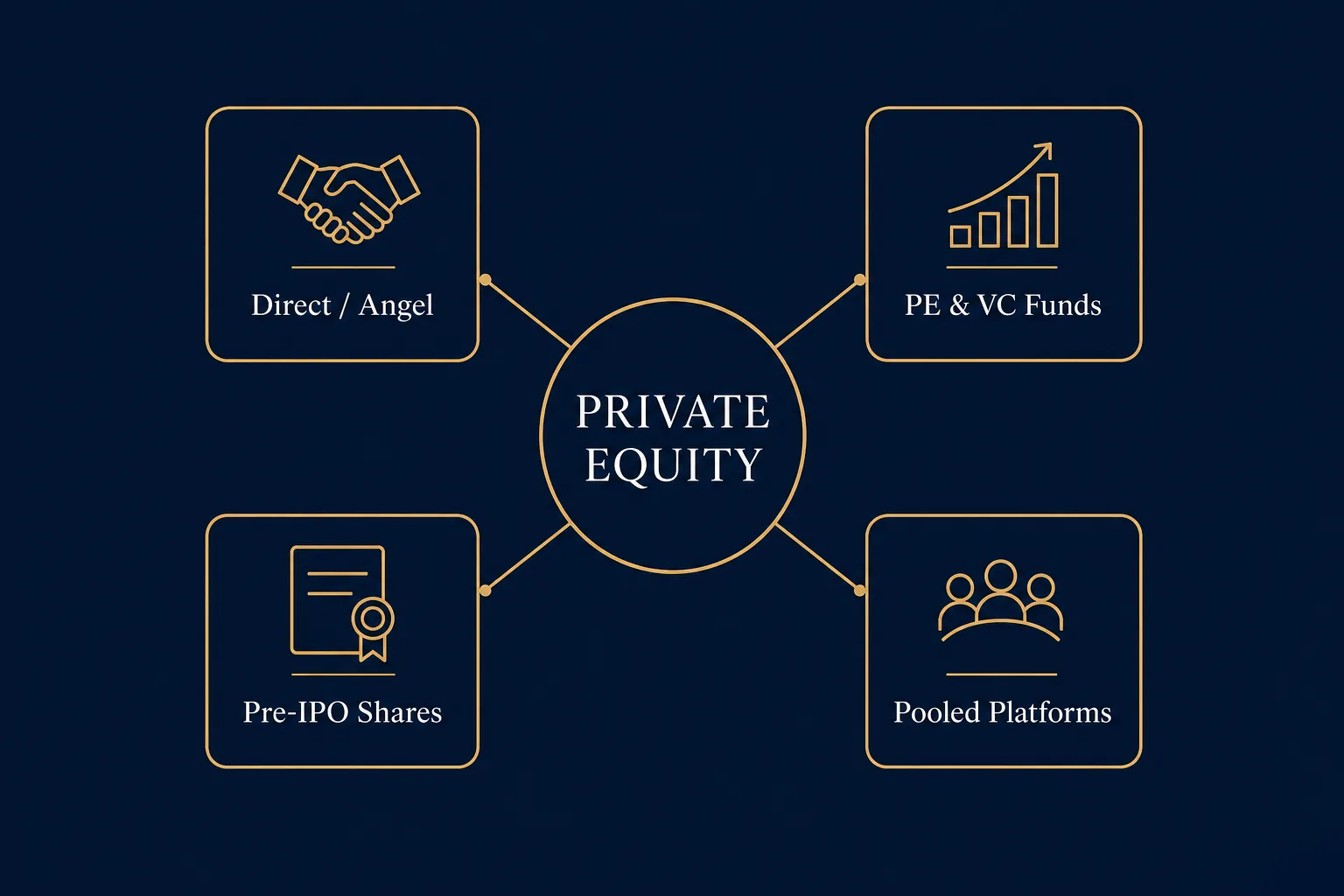
At its simplest, this is owning equity in businesses that are not listed on a public stock exchange. That covers a wide spectrum: early-stage startups raising their first outside money, growth-stage firms scaling toward a possible listing, and mature, cash-generative companies held by private equity firms.
The main ways individuals participate look quite different from one another:
- Direct or angel investment, buying shares in a single startup or founder round.
- Private equity and venture funds, where your money is pooled with others and run by a professional manager.
- Pre-IPO or secondary shares, buying into a late-stage private company before it lists.
- Pooled vehicles and platforms that package access to a range of deals.
This is one asset class holding very different risk profiles. A seed-stage startup and a buyout fund holding profitable businesses are both “private,” but they behave nothing alike.
The case for it: why investors bother

Access to growth before the IPO
Because listings come later, much of the early value is captured while a company is still private. Investors who get in at that stage are buying into the growth story rather than the maturity that a public listing often signals. For the right company, that earlier entry point is the whole appeal.
Return potential and the illiquidity premium
Private markets have historically offered higher target returns than public equities, partly as compensation for locking up capital that you cannot sell on a whim. The catch, and it is a big one, is dispersion: the gap between the best and worst managers is enormous, far wider than in public markets. Picking a top-quartile fund and a bottom-quartile fund is the difference between a strong result and a disappointing one. A Harvard Business School working paper examining whether the case for private equity still holds makes the point that the return advantage is real but conditional: it depends heavily on manager selection, entry valuations, and the interest-rate environment you invest into.
The average is not the opportunity; the selection is.
Diversification
Private holdings tend to move on their own schedule rather than swinging with daily public-market sentiment, which can smooth a portfolio’s ride. Private ownership also lets management teams make long-horizon decisions without the pressure of hitting quarterly earnings targets, a genuine advantage for building durable value.
The case against it: the risks nobody should skip
Illiquidity and long lock-ups
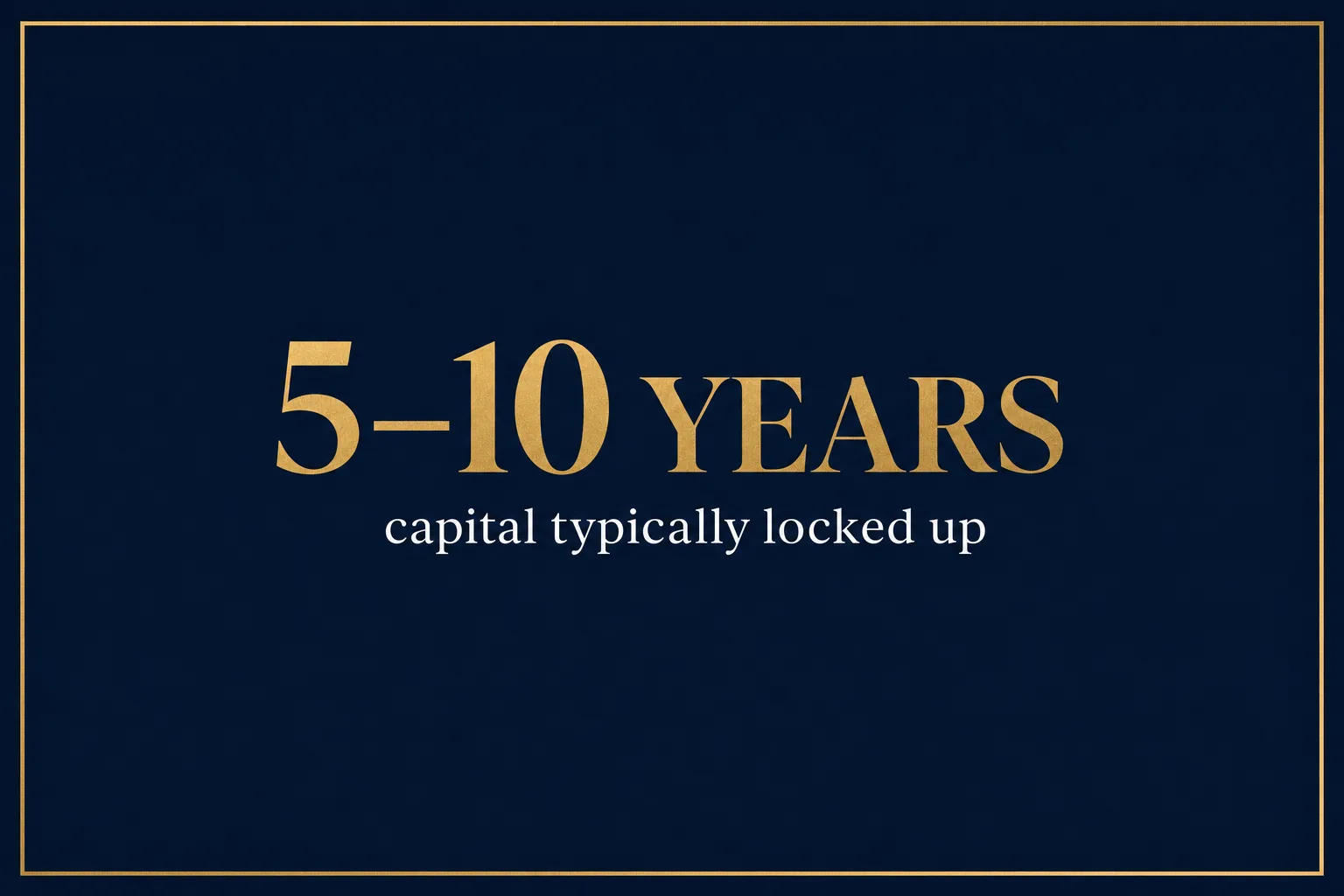
This is the single biggest trade-off. Capital committed to a private fund or company is typically tied up for five to ten years, sometimes longer. There is no exchange to sell on if you change your mind or need the money. Secondary sales exist but can be slow and come at a discount. If you might need the cash, this is the wrong home for it.
If the company goes public you could make a lot of money. If the company goes bust you will lose your investment.
Higher risk and information asymmetry
Private companies disclose far less than public ones. There are no quarterly filings to scrutinise, valuations are harder to pin down, and early-stage failure rates are high. That opacity changes how these businesses even behave with capital; research on how private and public firms invest differently documents that private firms respond to their own internal conditions rather than to a public share price, which cuts both ways for an outside investor trying to judge value. You are relying more on the manager’s diligence and less on the market’s, so the quality of the people you invest alongside matters more than usual.
Fees, minimums, and the access problem
Ask on a forum whether private investing is worth it and you will often hear a blunt answer: the best deals get taken by institutions and large family funds before an individual ever sees them, and what filters down can carry high fees and steep minimums. That skepticism is worth taking seriously. It is not that individuals cannot invest well in private markets; it is that access quality varies wildly, and poor deal flow wrapped in a slick pitch is a real hazard. The asset class is not usually the problem, the entry point is.
So, is it worth it? A short framework to decide
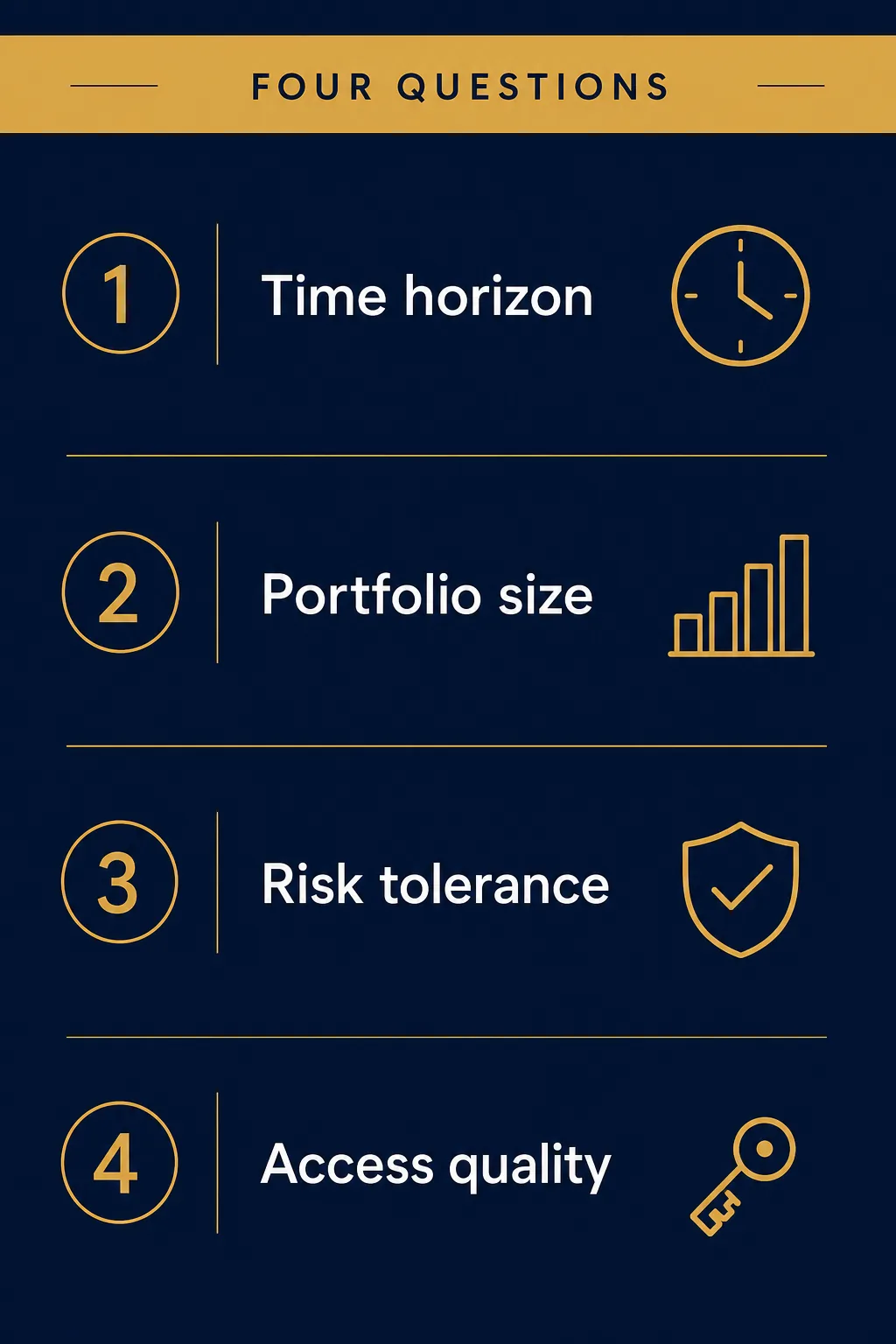
Rather than hand down a verdict, it is more useful to give you a lens. Run yourself through four questions:
- Time horizon. Can you lock up capital for five to ten years without touching it? If not, stop here.
- Portfolio size. Can this be a small, deliberate allocation, money you genuinely do not need liquid, rather than a core holding?
- Risk tolerance. Are you comfortable with the possibility of a total loss on any single position and wide swings in outcome?
- Access quality. Is your realistic route to well-sourced, vetted deals, or only to whatever happens to land in your inbox?
The takeaway: it can be worth it if it is a measured allocation and if you can reach quality opportunities. It is not worth it if it is money you will need soon, or if your only available route is low-quality deal flow. The decision is less about the asset class in the abstract and more about your specific situation and your specific access.
How to invest in private companies as an individual
Accreditation and the rules
Access is usually gated. Many private offerings are limited to investors who meet qualification standards based on income or net worth, a framework regulators use to restrict certain deals to those presumed able to bear the risk. In the U.S., that accredited-investor definition reaches beyond pure wealth measures to include people holding certain professional financial certifications. Rules differ by jurisdiction, so confirm your own status and local requirements before you go looking.
| Route | What it means | Key trade-off |
|---|---|---|
| Direct / early-stage | Angel investing or joining a founder round puts you directly into a single company. | Highest risk and highest potential reward; demands real diligence, betting on one team and one idea. |
| Private equity & venture funds | Pooled, professionally managed funds spread your capital across multiple companies and hand selection and oversight to a manager. | Minimums are typically high, and the manager you choose largely determines your outcome. |
| Pre-IPO & secondary shares | Buying into late-stage private companies, often ones widely expected to list, directly or through a secondary marketplace where existing shareholders sell. | Exposure to more mature businesses than early-stage bets, though pricing and availability can be uneven. |
| Platforms & membership networks | Curated platforms and members’ networks that source and vet deals, since that is where individuals struggle most. | Chooses transparent, vetted access over sifting raw deal flow alone. |
Platforms and membership networks
Curated platforms and members’ networks exist precisely because sourcing and vetting are where individuals struggle most. This is where a group like Beaufort Society fits: a membership route intended to give individual investors access to private opportunities that have been screened, rather than leaving them to sift raw deal flow alone. It is also the honest answer to the “reviews and complaints” instinct many searchers arrive with. The protection against a bad experience is not avoiding private markets entirely; it is choosing transparent, vetted access over whatever is loudest.
What to look for before you commit
Before signing anything, work through a short due-diligence checklist:
- Deal sourcing. Where do the opportunities come from, and why do you get to see them?
- Fee transparency. Are all costs, including carried interest and management fees, laid out plainly?
- Track record and dispersion. How has the manager performed across cycles, not just in one good year?
- Alignment. Does the manager or platform invest their own money alongside yours?
- Time horizon. Does the expected lock-up match what you can genuinely commit?
- Healthy skepticism. Treat any promise of guaranteed or outsized returns as a warning sign, not a selling point.
Due diligence is your real protection here. It is slower and less exciting than the pitch, and it is the single best defence against the complaints that circulate online.
Frequently asked questions
Is investing in private companies worth it?
How can I invest in private companies pre-IPO?
What’s the difference between private equity and buying a private company directly?
Do I need to be an accredited investor?
What’s the best way to access vetted private opportunities?
Investing in private companies is worth it as a disciplined, modest allocation for people who can tolerate having their capital locked up for years and who can reach genuinely vetted opportunities. It is a poor fit for money you might need soon. More than returns or hype, the deciding variable is access: get that part right, and the rest of the decision becomes far clearer.