
You make money investing in startups when a company you backed early becomes worth more, and you sell your stake at that higher value. The upside can be large, but so is the risk, and the timeline runs in years, not months. Knowing how those returns actually happen is what separates speculating from investing with a plan. Beaufort Society gives members access to vetted private opportunities, plus the context to weigh them properly.
How startup investing actually makes you money
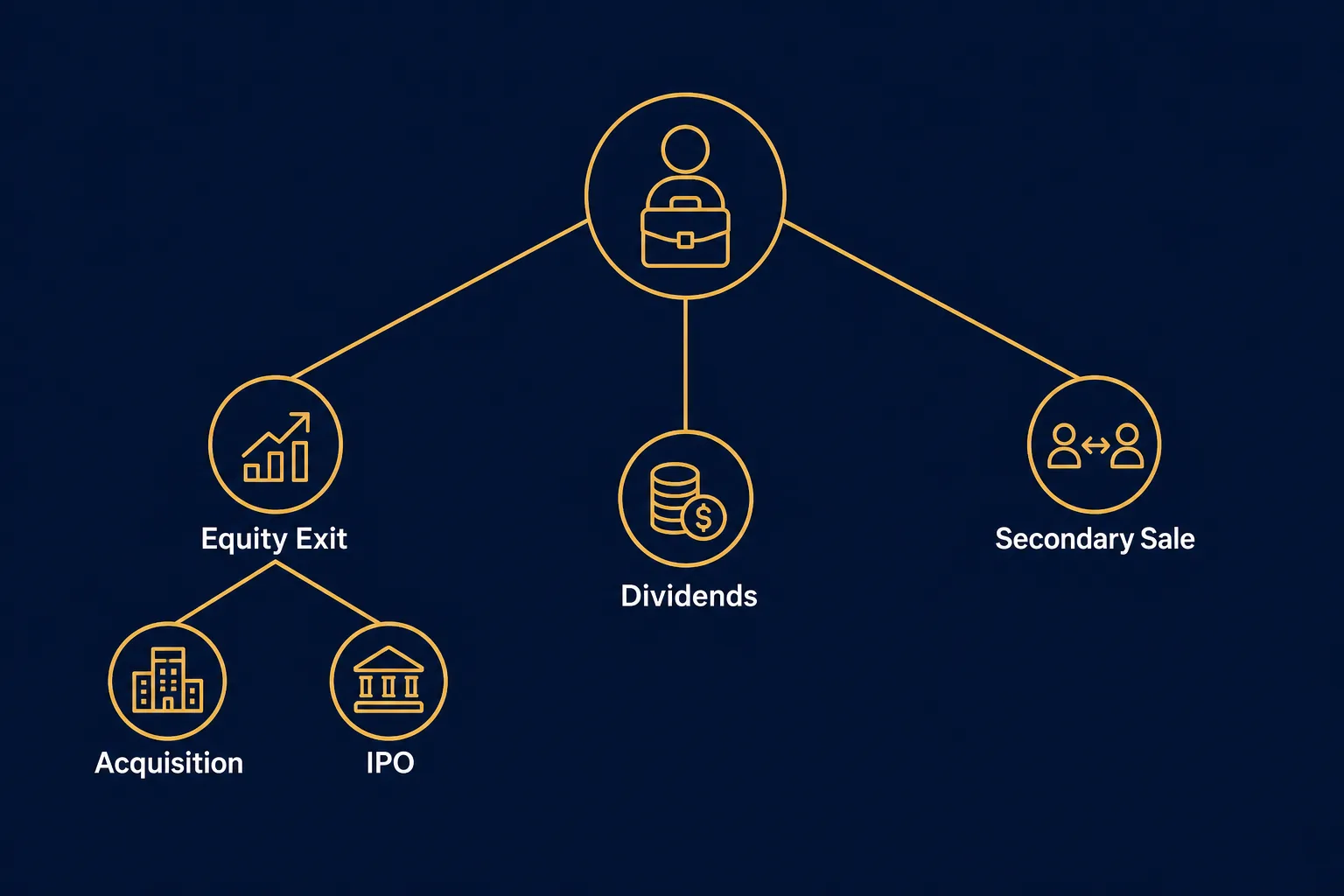
Money flows back to a startup investor in three ways, and one of them does most of the work.
Equity appreciation and the exit
The primary route is equity appreciation. You buy shares early, when the valuation is low, and you profit when you sell them at a higher valuation during a liquidity event. That event is usually an acquisition, where a larger company buys the startup, or an initial public offering, where the company lists on a stock exchange. Buy in at a $5 million valuation and sell when the company exits at $50 million, and your stake is worth roughly ten times what you paid, minus the dilution from later funding rounds. As Esade Business School notes, returns come from spotting companies with strong growth potential before the wider market prices that potential in.
Dividends and revenue-share (the exception, not the rule)
Most startups pour every dollar back into growth, so dividends are rare early on. Some deals are structured as revenue-share or profit distributions, usually with established small businesses rather than high-growth tech ventures. Treat these as the exception. A company paying you cash early is generally not chasing the scale that produces a large exit.
Secondary sales
You do not always have to wait for an IPO or acquisition. In a secondary sale, you sell your shares to another investor before a formal exit. It is a route to earlier liquidity, though secondary markets for private shares are thin and pricing can be uncertain.
Can you actually make money? The risk-and-reward reality

Yes, you can, but the honest picture matters. Startup returns follow a power law: most companies fail or return little, while a small number of winners generate the bulk of the gains. One company returning 30 times your money can outweigh several that return nothing. That is why serious investors diversify across many deals instead of betting on one.
One company returning 30 times your money can outweigh several that return nothing.
Two other realities shape your returns. The first is illiquidity: your money is typically locked up for five to ten years before an exit lets you out. The second is timing. A peer-reviewed study on financing and innovation in startups shows how tightly a young company’s funding and its ability to keep innovating are coupled, and how sensitive both are to cash-flow timing. A promising product will not return your capital if the company runs out of runway before it scales.
How much money do you need to start (and the “little money” route)
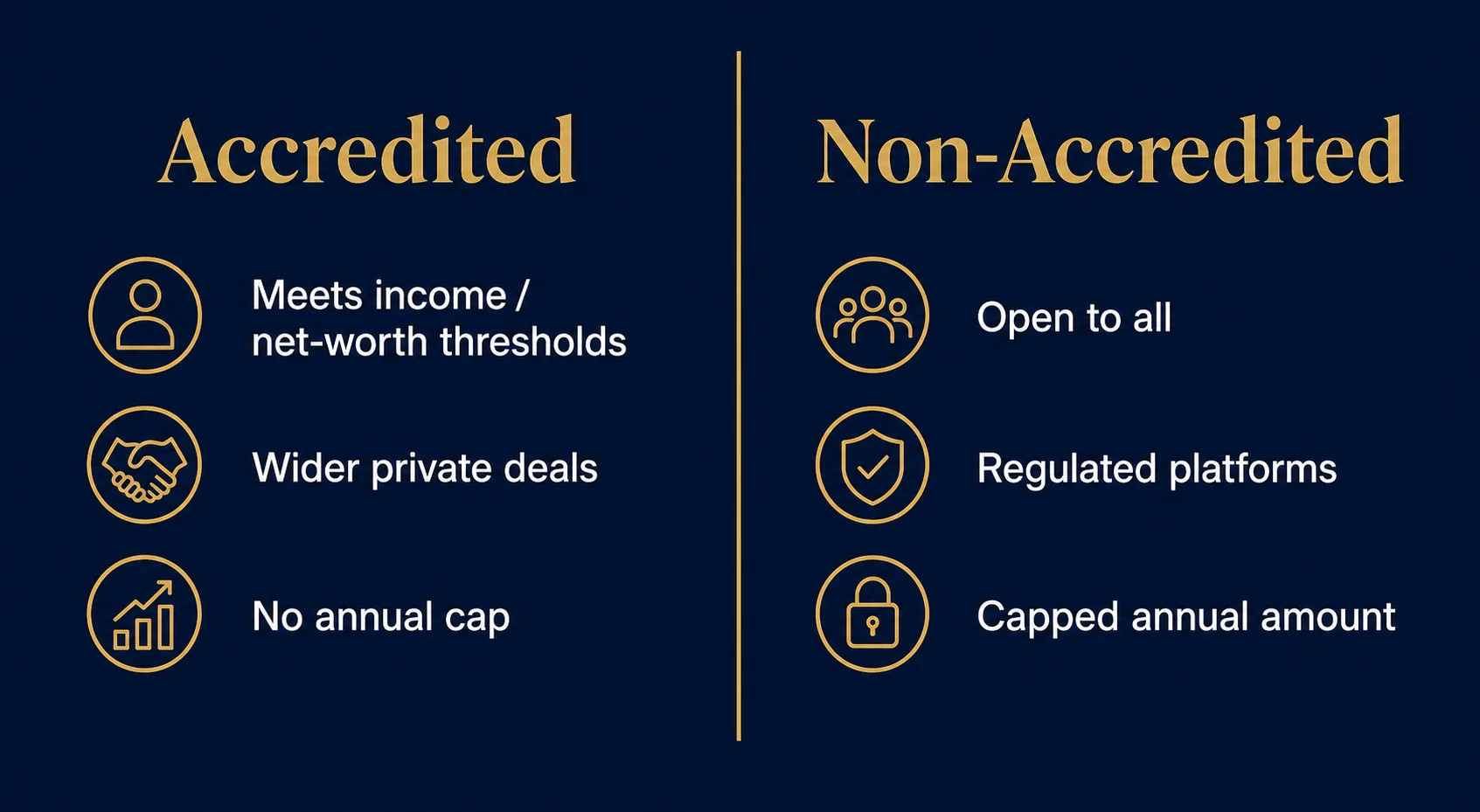
Investing in startups with little money
You no longer need to be wealthy to begin. Regulated equity crowdfunding platforms let non-accredited investors buy small stakes, sometimes from a few hundred dollars. The key distinction is between accredited investors, who meet income or net-worth thresholds and can access a wider range of private deals, and non-accredited investors, who are limited to regulated platforms and capped annual amounts. Both can build a startup portfolio; the accredited route simply opens more doors.
| Accredited investors | Non-accredited investors | |
|---|---|---|
| Qualification | Meet income or net-worth thresholds | No thresholds to meet |
| Access | A wider range of private deals | Limited to regulated platforms and capped annual amounts |
| Can build a startup portfolio? | Yes | Yes, the accredited route simply opens more doors |
Setting realistic return expectations
Be skeptical of any promise to turn $1,000 into $10,000 in a month. Startup investing is illiquid and multi-year, so that timeline does not apply. A question like “how much will $10,000 be worth in 10 years?” has no fixed answer: a startup portfolio could return nothing or several multiples, depending entirely on which companies exit. Generating $1,000 a month in income is also not what early-stage equity is built for, because returns arrive as a lump sum at exit, not a monthly yield. The productive mindset is portfolio thinking: spread capital across several deals, expect most to underperform, and let the winners carry the result.
Where to invest in startups
Several routes exist. Equity crowdfunding platforms handle small tickets and regulatory compliance. Angel networks and syndicates pool individual investors around specific deals. Venture funds let you invest through professional managers. Curated member networks offer access to pre-vetted private opportunities. For a view of how founders raise across these channels, the U.S. Small Business Administration’s guide to funding a business lays out the range from self-funding to outside investors, the other side of the table you are sitting at.
What to look for in a startup investment platform or network
Judge any platform on deal vetting (who filters the opportunities, and how), transparency (clear terms, fees, and company data), minimum investment, whether secondary sales are possible, and trust signals like track record and regulatory standing. A route that pre-screens deals and gives you real information is worth more than one that simply lists everything. This is where Beaufort Society sits for its members: vetted opportunities, with the context to assess them.
How to invest in a startup, step by step
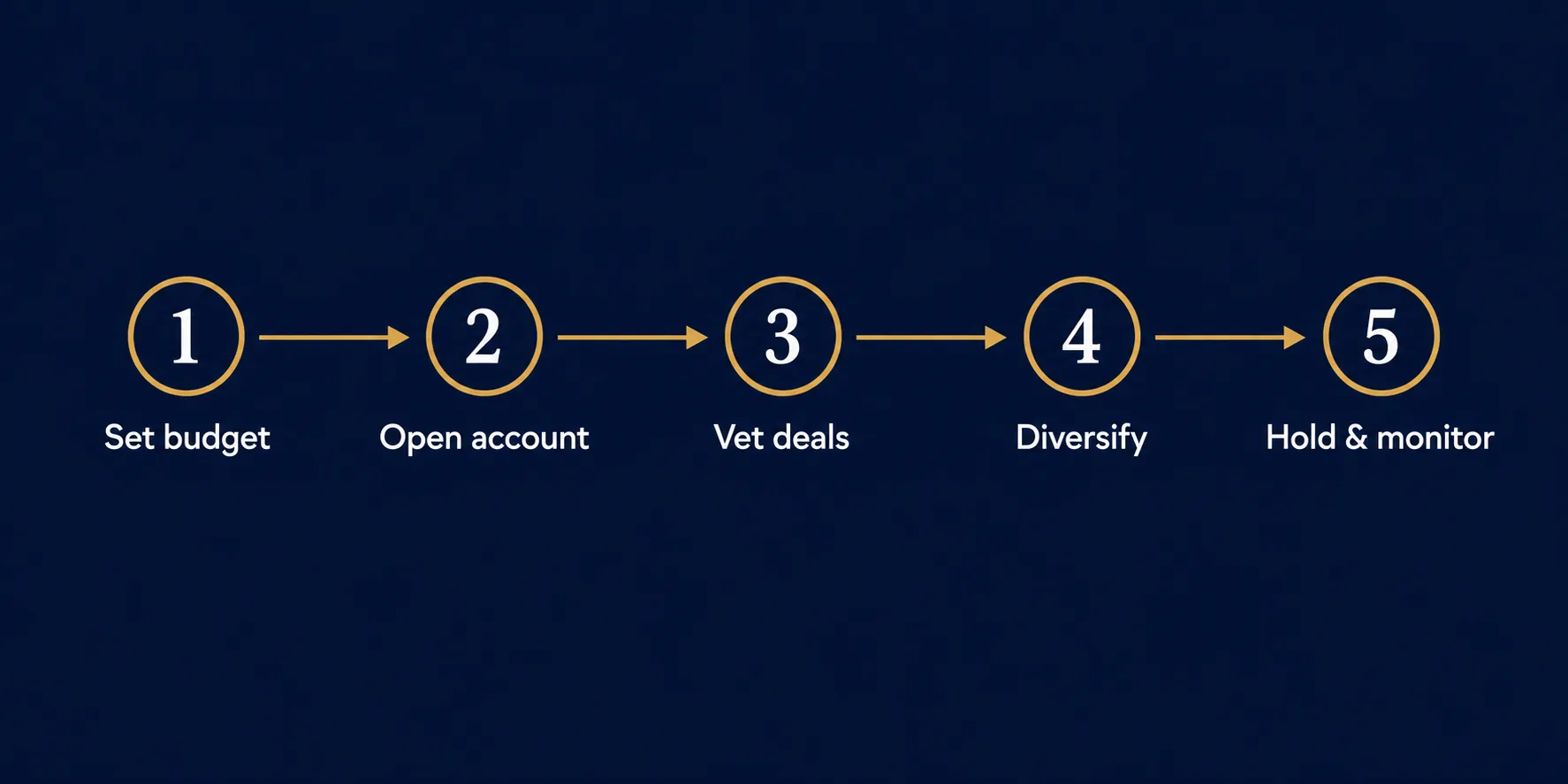
- Set your budget and decide what share of your portfolio you can afford to risk on illiquid, high-variance assets.
- Open an account on a regulated platform or join an investment network.
- Research and vet each deal: the team, the market, current traction, and the terms.
- Invest across several companies rather than concentrating in one.
- Hold, monitor progress, and plan for the eventual exit.
How to evaluate a startup before you invest
Strong due diligence separates disciplined investors from gamblers. Look hard at five things: the founding team and their track record; the size and growth of the market; traction, meaning real revenue, users, or momentum; the valuation and deal terms on offer; and how the company plans to spend the money. A brilliant idea attached to a weak team or a poor valuation is not a good investment. A solid team in a large, growing market at a fair price is where returns tend to come from.
Frequently asked questions
Can you make money investing in startups?
How do you invest in startups with little money?
How much will $10,000 invested be worth in 10 years?
How much do I have to invest to make $1,000 a month?
Is startup investing worth it for beginners?
Returns in startup investing come from patient, diversified, disciplined early ownership, and from reaching opportunities worth backing in the first place. That pairing, vetted access and informed participation, is what makes membership a considered way in rather than a gamble.