
It is rare for global risk to move from sideshow to centre stage in a matter of hours, yet Week 41 delivered exactly that kind of drama. Late-week selling swept through international markets with an intensity not seen since the COVID-19 crash for equities and in the world of crypto … the volatility and scale of losses set all-time records, far surpassing even the darkest days of previous crypto winters. What began as tremors around tariffs and trade quickly erupted into a full-scale correction, scattering risk appetite and resetting expectations in real time.
Trading desks from Singapore to Frankfurt, New York to São Paulo, found themselves not only repricing portfolios but re-examining narratives. This was not the slow seeping of uncertainty, but the arrival of panic; one that spared few sectors and left even seasoned allocators wondering where shelter could be found next. Suddenly, volatility was back, and price discovery meant severe pain and liquidations.
Markets, for months happy to chase rallies powered by hope and missing data, were forcefully reminded that fundamentals matter. And when those fundamentals turn, they turn with violence. If last week’s cautious optimism was the quiet before the storm, this week’s abrupt rout was the thunderclap investors have been bracing for all summer long.
Recap: Where We Left Off (Week 40)
Where we left off from last week’s dispatch: market mood had unfolded under a peculiar cloud, with key US government data suspended during the shutdown, leaving markets trading in a vacuum with optimism thriving not despite missing information, but precisely because of it. Equity rallies followed the “data blackout bull market,” as dovish Fed hope surged while real numbers stayed off the tape.
European shares soared on conviction, pushing the STOXX 600 to fresh highs, while Tesla turned regulatory agility into a delivery record and tax-credit triumph; though shares still slipped, proving markets price the future, not the quarter. Oil sagged as OPEC played a waiting game, and gold’s shine persisted amid simmering macro risk.
For private equity and allocators, the lesson was discipline over distractions. Public markets cheered information gaps, while smart capital used uncertainty to seek mispriced assets. As October’s fog settled, it remained an open question whether this clarity-free optimism was real strength—or just borrowed time, waiting for fundamentals to return.
If you missed last weeks dispatch you can find it here: Government Shutdowns, Tesla Tax Credits & the Art of Missing the Data
This Week: Panic, Policy, and Price Discovery; When Tariffs Turned Optimism into Correction
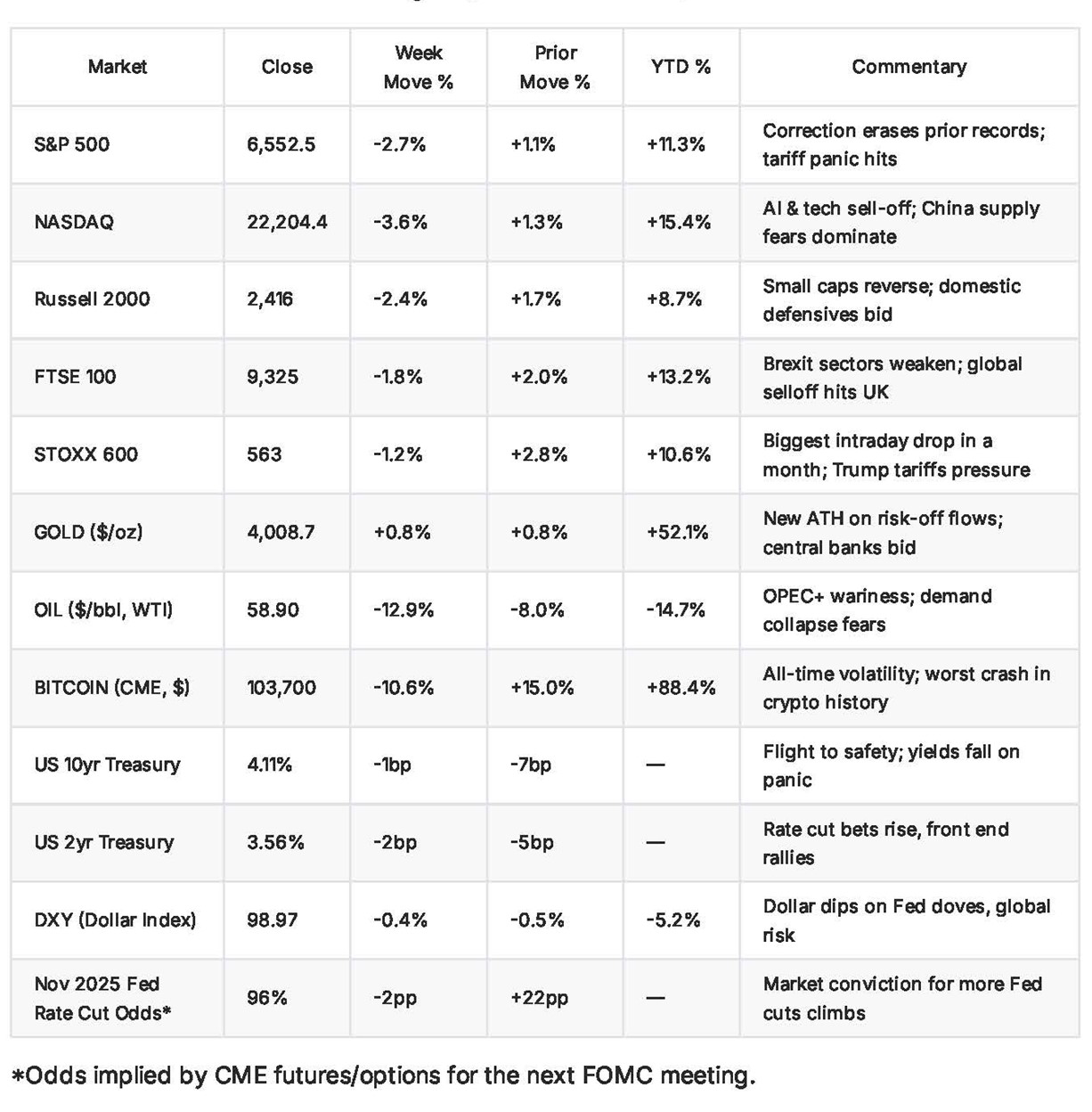
Weekly Market Table
US & Global Equities
-
S&P 500, NASDAQ, and Russell 2000 erased weeks of gains in a sharp correction, as tariff panic and global risk aversion dominated the narrative.
-
Tech and AI leaders reversed aggressively; China supply chain fears and megacap profit-taking fueled outsized losses in the NASDAQ.
-
Small caps and domestic defensives underperformed, showing that no equity market offered real shelter as volatility spiked.
-
European indices (STOXX 600, FTSE 100) suffered their biggest intraday drops in a month, pressured by US moves and fresh Brexit and Trump trade headlines.
Gold, Digital Assets and Other Assets
-
Gold powered to a new all-time high above $4,000/oz, as risk-off flows intensified and central banks bid safe-haven assets.
-
Oil collapsed nearly 13% on demand fears and OPEC+ caution, revisiting lows not seen since early summer.
-
Bitcoin futures dropped over 10%, not merely underperforming but logging the worst weekly price crash and volatility in crypto market history.
Macro & Policy
-
US Treasury yields fell again, with the 10-year near 4.11% and the 2-year at 3.56%, as the Fed pivoted further dovish and defensive on global turmoil.
-
The dollar index slipped as rate cut bets and global growth fears eclipsed any US domestic resilience.
-
Market-implied odds for a November Fed rate cut rose, then slightly faded, but conviction in future easing remained high.
Geopolitical Analysis
-
Trump’s renewed tariff threats on China amplified cross-market volatility and forced a global repricing of risk assets.
-
European political risks, especially Brexit-sensitive sectors in the UK, were punished further on evidence of global capital seeking safer harbours.
-
Ongoing US-China frictions, OPEC+ indecision, and renewed investor concern about global policy coordination shaped every major asset class.
Not a great week for “Uptober”; with this much carnage it may be time to rename it “Rektover.”
What’s Pertinent This Week (Week 41)?
-
Tariffs Reignite Real Risk: President Trump’s sudden tariff escalations and China’s stern countermeasures dragged geopolitics to the front of every trading screen, forcing a dramatic global repricing of risk and erasing weeks of equity market gains. This wasn’t a policy sideshow … it was the defining factor that drove volatility, sentiment, and sector moves everywhere.
-
Correction Arrives Without Warning: A hard and fast equity selloff reminded investors that crowded trades and technical momentum offer little protection when fundamental anxiety returns. The S&P 500, NASDAQ, and global benchmarks saw their sharpest drops since spring, led by a rout in technology and small caps. The correction didn’t just reset valuations; it reset market psychology.
-
Crypto’s Worst Week Ever: While equities suffered, the digital asset space endured its most brutal week on record, as Bitcoin futures crashed over 10% and daily realized volatility hit unprecedented levels. The hope-fuelled “Uptober” narrative was obliterated by the reality of “Rektover” … a chastening for even the most hardened speculators.
-
Return of the Safe Haven Bid: Gold powered to new highs, treasuries rallied sharply, and the US dollar softened, as capital sought traditional safety in the storm. OPEC+ caution and demand fears battered oil, adding to the cross-asset sense of instability.
-
Policy and Data Blackout Anxiety: Central banks faced calls for rescue with limited room for manoeuvre, as economic data resumed post-shutdown but offered only discomfort, stubborn inflation, softening growth, and a market hungry for dovish pivots. Rate cut odds see-sawed but ended the week with conviction for more easing.
-
The Age of Visible Risk: The key lesson? Markets can ignore risk for a time, but when policy shocks and profit-taking converge, price discovery becomes swift and merciless. Global capital is now searching for true defensives and real diversification, not just hiding in the usual playbooks.
This was the week where narrative and volatility converged, and “correction” was no longer a whisper but a headline. The market climate shifted palpably—optimism now trades at a much steeper premium.
Private Equity’s Macro Insights
Lessons Learned from the Correction
It began at 4:12 a.m. with a London partner’s phone lighting up with the Asian screens a sea of red, the ghost of last night’s debate still tingeing the first coffee. By breakfast in New York, burnt margin calls filled the air, and even the boldest GP needed a triple espresso to log onto Zoom.
When Momentum Falters, The Leverage Syllabus Changes
This correction started as a whisper about tariffs and morphed by midweek into a crash course in leverage gone wild. “Growth at any price” didn’t simply stall—they became exhibits in the hazards of financial nihilism, where capital chased stories unconstrained by risk. Leverage that looked brilliant on Monday became a Halloween ghost by Thursday: forced liquidations swept the room, and the most speculative holdings were auctioned off at fire-drill prices.
You could see the fallout in deal flow … German logistics and US specialty clinics held their ground, while anything with “next-gen” in the deck headed for the late-night revision pile. Unicorn chasers, still thumbing highlight reels, were suddenly Googling “cross-default” and “position limits” before lunch. Even private equity, famed for its patience, couldn’t escape the emotional pendulum: bravado on Monday, existential anxiety by Thursday.
Through it all, the only real defenders were unglamorous assets: infrastructure, healthcare, and businesses built for duration, not dopamine. As one wag noted, “If patience paid performance fees, this week would make us all billionaires.” The final lesson: leverage is a power tool, not a strategy. And when correction comes … the theory turns brutally real.
Discipline in the Age of AI Auto-Trading
This week’s correction was shaped not just by human nerves, but by market machinery. The rise of AI-driven auto-trading meant liquidity vanished more quickly, but the recovery snapped back even faster.
Algorithms dumped risk in cascades, then reversed course as signals shifted. Managers who ran scenario drills on cash flow and leverage felt prepared, but even they found a new classroom: one where an invisible hand set the tempo. Process matters, but digital awareness is now mandatory.
The best recalibrates execution, patience, and discipline whilst watching the pace of the robots with equal care as the humans.
Optionality Over Urgency
Those who resisted FOMO and delayed closes now hold stronger cards. Extensions, once feared, now look prudent. In market classrooms, it’s not always the fastest who finish best … it’s those who answer with timing.
After such a large correction, the outlook on management evolves with prudence and strategic patience are no longer defensive stances, but competitive edges. Now is the time to revisit investment memos, re-evaluate stressed assets, and carefully stage commitments … avoiding the urge to “do something” merely for activity’s sake.
The best will focus on bolt-ons or opportunistic carve-outs where value is visible but avoid rushing unless the path is well-lit. Deal teams should run fresh stress-tests on liquidity, vendor agreements, and supply chains, leveraging lessons freshly learned from the market storm.
Most importantly, transparency with LPs and stakeholders becomes paramount. The best managers communicate when stepping back, explain their rationale, and prepare dry powder for opportunities that patient curation will uncover. If the last round of the market was about speed and allocation, this phase is about discernment, dialogue, and the art of putting patience on the offensive.
Context Beats Confidence
So, the dust has settled, the books are scorched and the bravado has vanished—what’s next, really, when you’ve been wiped out? Every humbled committee faces this over bruised espressos and silent deal sheets. The urge to jump straight back in is as perennial as October rain. Resist it.
Reframe the moment: volatility is not a verdict, but an invitation. Become a student again—probe, map sectors, admit gaps, and don’t shy from asking what went wrong. Stage your re-entry: the best next deals are found weeks, not days, after a rout, often in warrants, secondaries, or overlooked carve-outs.
Above all: a setback relaunches the syllabus. Courage isn’t re-entering blindly; it’s trusting process, curiosity, and slow-building conviction. The real alpha always accrues to those who honour context, not just confidence.
In short: after this cycle’s wipeouts, the only thing riskier than humility is failing to have any. The next opportunity will not suit the loud or the fast—it will suit the humble, the curious, and the ready.
In a week where leverage and emotion collided with digital speed, the greatest lesson is simple: private equity’s most valuable seat still goes to the disciplined, the patient—and, now, the AI-literate.
A Deep Dive into Tariffs
It’s dawn in Gibraltar. The Levanter clouds hang low over the rock and the screens in Irish Town cafés flicker with headlines, not football. WhatsApp groups vibrate like the straits in a squall .. “100% China tariff, effective Monday” … as the first cortado is poured and someone jokes that London is now just Europe’s best suburb for tariffs.
A Brief History: The Trump Tariff Revival
Since President Trump returned, the market’s felt like Main Street meets “Game of Thrones.” Section 301 and 232 tariffs returned with a vengeance. First digital trade and metals, then a 10% blanket, then a 60% “strategic” strike on China, and now this month’s thunderclap: 100% tariffs across Chinese imports.
China fired back at rare earths; Brussels and Mexico, not to be left out, quietly bolted up their own defences. What began as “leverage” became a game of border chess … tweeted in 280-character moves.
Why the Escalation? Trump’s Painful Logic
Trump explicitly stated the new 100% China tariff is designed to retaliate for China’s recent export controls on rare earth minerals and critical technology inputs. On Truth Social, he accused Beijing of “an extraordinarily aggressive position” and “very hostile” global trade moves, including plans to roll out sweeping restrictions on exports of rare earths … elements essential to electronics, defence, and high-tech manufacturing. Trump framed the tariff escalation as sticking up for “America First,” but acknowledged in his own post that “though painful, [tariffs] will be a good thing in the long run for the U.S.A.”.
Why Rare Earths? Because the World Runs on Them!
China controls more than 90% of global rare earth magnets, making the new export rules a powerful economic weapon and negotiation tactic. The White House and many U.S. strategists believe Chinese restrictions are pitched to intentionally disrupt U.S. supply chains. And that Trump’s dramatic tariff response is meant both to pressure Beijing and to force long-term supply chain “reshoring” at home.
Economists, however, are frank: this is “mutually assured pain.” Market models show American consumers may face 2–4% additional inflation and GDP growth could be hit by up to 2% — a steeper consequence than many expect for China itself.
There is wide agreement in economic and geopolitical circles that both sides are playing for leverage, not certainty, with rare earths and high-tech dominance as the stakes.
Where We Are: Volatility Reigns
The S&P’s off 21%, VIX is peaking, half the private equity pipeline is frozen. In Gibraltar and Frankfurt, deal rooms whisper about panic clauses, local supply wins, and “headline hangover.” Even the fish are happier staying close to home.
Where Next? Crystal Balls and Political Weather
USTR takes midnight embassy calls, Brussels is drafting countermoves. Instinctively, capital chases AI, defensive infrastructure, regulated B2B; global or FX-exposed deals are left for the next brave committee.
Every memo ends the same: “What’s our tariff risk, and who’s going to tweet next?”.
So …. when the next cargo sails, are you safely anchored, or just hoping you’re not left holding the world’s most expensive ballast?
America First. Europe Patient. China Furious. Gibraltar reading the wind and watching the ships pass. In tariff season, only the nimble dine, the greedy, inevitably, get heartburn.
Ed’s Closing Bell
Sunday’s ferry across Gibraltar’s straits is less about the destination than the journey—a gentle reminder that, just like markets, the most seasoned travellers navigate by intuition and experience, not just by chasing the latest headlines. This week’s market turnaround felt like a captain steering through fog: patient hands and a steady eye were essential as volatility, tariffs, and tech drama swept over the bow.
Markets, like passengers, prefer predictable routes and steady captains. Yet autumn offers its own tradition: surprises remain, visibility is poor, and risk managers in every marina are swapping stories about “the big one” that just hit. Tariffs may prove to be the tide turning against momentum; rare earths could be the next bottleneck in the global engine room; and private equity faces the perennial puzzle—can volatility be turned into opportunity without sacrificing discipline?
The lighthouse message is clear: when risk emerges from the mist, the wise investor moves by fundamentals and patience—not the loudest tariff tweet.
What About Next Week 42?
-
Fed Policy Clarity: Another rate cut? The market is stuck in “wait and see”—all eyes on December’s signals and any hawkish pivots.
-
China’s Policy Pivot: Next week’s Communist Party plenum may tip the stimulus scales—it’s worth watching whether growth jitters turn into cheques.
-
US Corporate Earnings: With Big Tech and industrials reporting, Friday’s correction could bring fresh volatility if expectations miss.
-
Global Supply Chain Resilience: Rare earths and commodity markets dominate planning—count on further headlines, not less.
For allocators and dealmakers, the advice is unchanged: stay nimble, prepare for volatility, and focus on due diligence above headlines. Next week’s brunch will taste sweeter if it’s eaten with conviction, not confusion.
As the closing bell echoes up from Wall Street, across the bay, and out to Europa Point. Remember sometimes the best trade isn’t being first or loudest, but the one with just enough ballast and just enough patience to wait for the weather to clear.
Rest up. Monday comes for both the bold and the careful. Just don’t mistake noise for signal—and never bet against the straits.
Final Words
As ever, these reflections are my own and not those of Beaufort Capital or anyone wise enough to keep their opinions strictly to café conversation. If these thoughts have entertained or provoked, so much the better. The best conclusions are those reached with your own research, a dash of doubting, and, when in doubt, a trusted professional (or a double espresso).
Markets change direction faster than a Levanter gust off the Rock, and sometimes that wind can scatter your best-laid notes and portfolio alike. Anyone claiming certainty about next week is either much braver than Ed. If you think you know exactly what’s coming, you probably don’t. Neither do I. That’s why markets, and these dispatches, stay informative but not the final word, that is yours and yours alone!
Stay inquisitive, sharpen your pencils and your instincts, and never bet your shirt on the week’s forecast!
Yours from the Rock well until next Sunday.
Personal Note
I have processed yesterday having felt the ramifications very personally and to summarise:

I was way, way too greedy!
Attached this week – the learnings being my cathartic processing of what just happened… now to pick up the pieces and move forward, and follow my own sound words in this article.
Further Reading
-
Trump 2.0 Tariff Tracker — Reed Smith (Trade Compliance Resource Hub)
https://www.tradecomplianceresourcehub.com/2025/10/10/trump-2-0-tariff-tracker/ -
Why Donald Trump’s Tariffs Are Failing to Break Global Trade — The Economist
https://www.economist.com/finance-and-economics/2025/10/08/why-donald-trumps-tariffs-are-failing-to-break-global-trade -
China’s New Rare Earth and Magnet Restrictions Threaten US Defense Supply Chains — CSIS
https://www.csis.org/analysis/chinas-new-rare-earth-and-magnet-restrictions-threaten-us-defense-supply-chains -
Private Equity Review H1 2025 — Grant Thornton
https://www.grantthornton.co.uk/insights/private-equity-review-h1-2025/ -
Stock Market Today: Dow Sinks as Trump Threatens Massive Tariff Increase on China — Yahoo Finance
https://finance.yahoo.com/news/wall-street-plunges-trump-threatens-203141770.html -
Consumer-focused PE Firms Navigate US Tariff Uncertainty — Private Equity International
https://www.privateequityinternational.com/pe-firms-navigate-us-tariff-uncertainty/ -
Fed Watch: Will Rate Cuts Return? — MarketPulse
https://www.marketpulse.com/markets/fed-fomc-meeting-preview-25-bps-cut-appears-baked-in-forward-guidance-is-key-implications-for-the-dxy-dow-jones-and-sp-500/ -
What China’s Plenum Means for Global Markets — Nikkei Asia (event/coverage hub)
https://www.global-nikkei.com/na_features/25/
These sources help separate the noise from the navigation—happy reading and fair winds for the week ahead!