
Some of the strongest returns of the last decade came from companies you could never have bought on the London Stock Exchange. By the time a fast-growing business floats, much of the early upside has already been captured privately. Getting in is harder: there is no continuous price on a screen, no one-click purchase, and no guarantee you can sell when you want to. This guide covers the parts that matter in practice: the real routes to invest, the tax reliefs that reward the risk, the dangers that rarely reach a pitch deck, and how you eventually get your money back. The focus is the UK, with a short note for anyone weighing overseas markets.
So, can you invest in unlisted companies? Yes. The tools exist and many are open to ordinary investors. The caveat is that some opportunities are legally restricted to certain investor categories, and every route asks more of you than buying a FTSE tracker ever would.
What “unlisted” actually means (and why it matches how you buy)
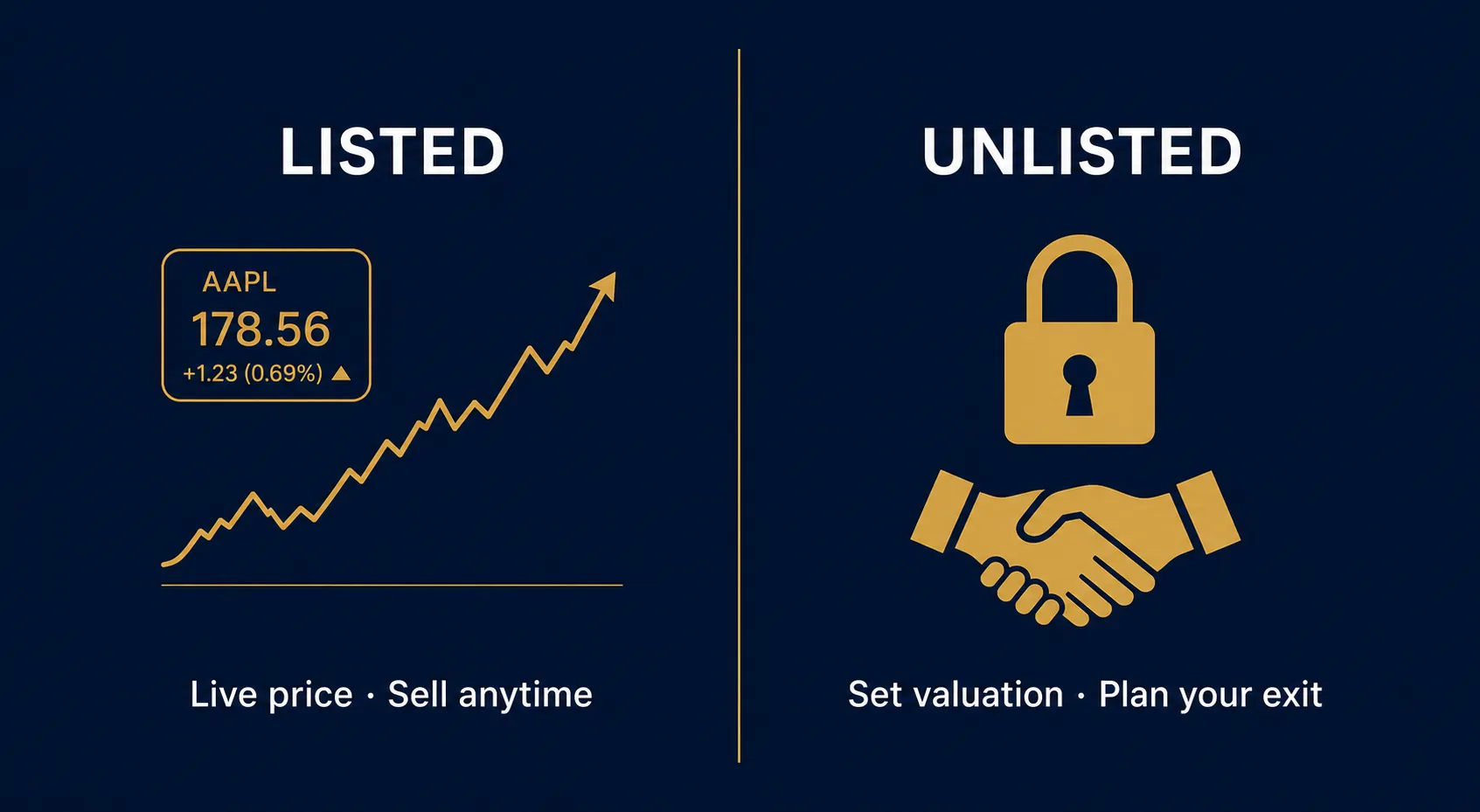
At its simplest, the meaning of unlisted shares is shares in a company that is not quoted on a public stock exchange. That covers a wide spread: private limited companies, pre-IPO scale-ups still raising rounds, and firms trading on some growth markets. What unites them is the absence of a deep, continuous public market in their stock.
That single fact shapes how you invest in an unlisted UK company. Because there is no live price, you buy in at a valuation that is set periodically and often negotiated rather than quoted minute to minute, so the price you pay depends on the round you join. You cannot assume a buyer will be waiting when you decide to exit, which means liquidity has to be planned rather than taken for granted. And you make your decision on whatever the company chooses to disclose, within its legal obligations, rather than the steady flow of filings a fully listed firm must publish. Each of these points changes what due diligence and patience the route demands of you.
Unlisted does not mean unregulated: the companies still answer to company law, and the way their shares are promoted to you is governed by financial rules.
Two distinctions are worth holding onto. And markets like AIM and Aquis sit in a grey zone, where shares are quoted and tradeable but not “listed” in the fullest Main Market sense. When people say unlisted, they usually mean genuinely private companies, the harder and more interesting end of the spectrum.
Can you legally invest in unlisted companies in the UK?
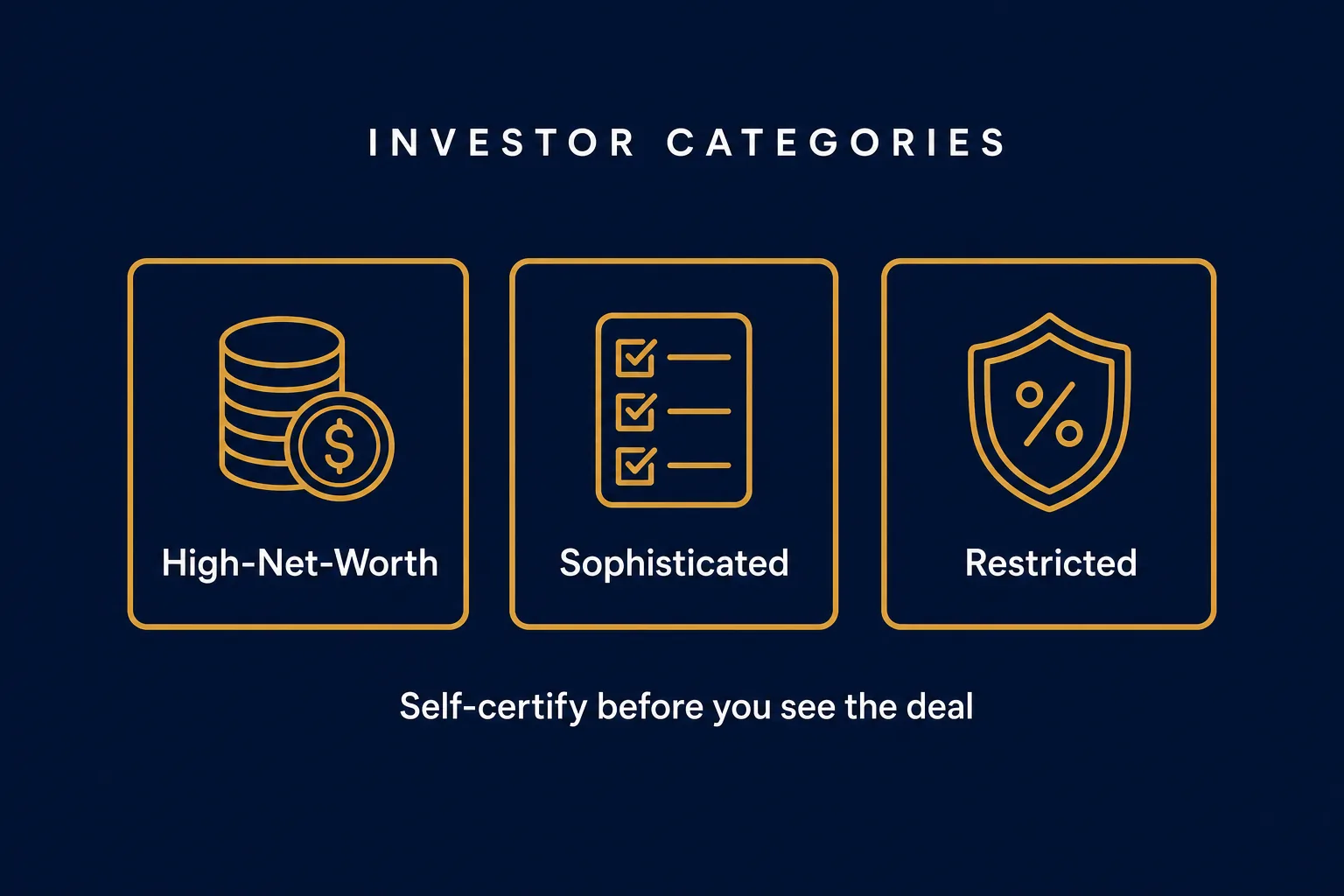
Yes, and for most people the first step to investing is confirming you are allowed to see the deal at all. Because private-company investments carry higher risk and less protection, the Financial Conduct Authority restricts how many of these opportunities can be marketed, so a lot of deals are offered only to people who fall into one of a few investor categories.
The common ones are high-net-worth investors, self-certified sophisticated investors, and restricted investors. Broadly, a high-net-worth investor is someone whose income or net assets sit above defined levels; a sophisticated investor can point to relevant experience, such as prior investments in unlisted businesses or a background in the sector; and a restricted investor commits to keeping this type of investment to a limited share of their overall assets. To invest, you typically confirm your status by signing a self-certification statement before a platform or promoter will show you certain deals. Read those statements properly rather than ticking a box: they exist to make sure you understand what you are taking on.
The main routes to invest in unlisted UK companies
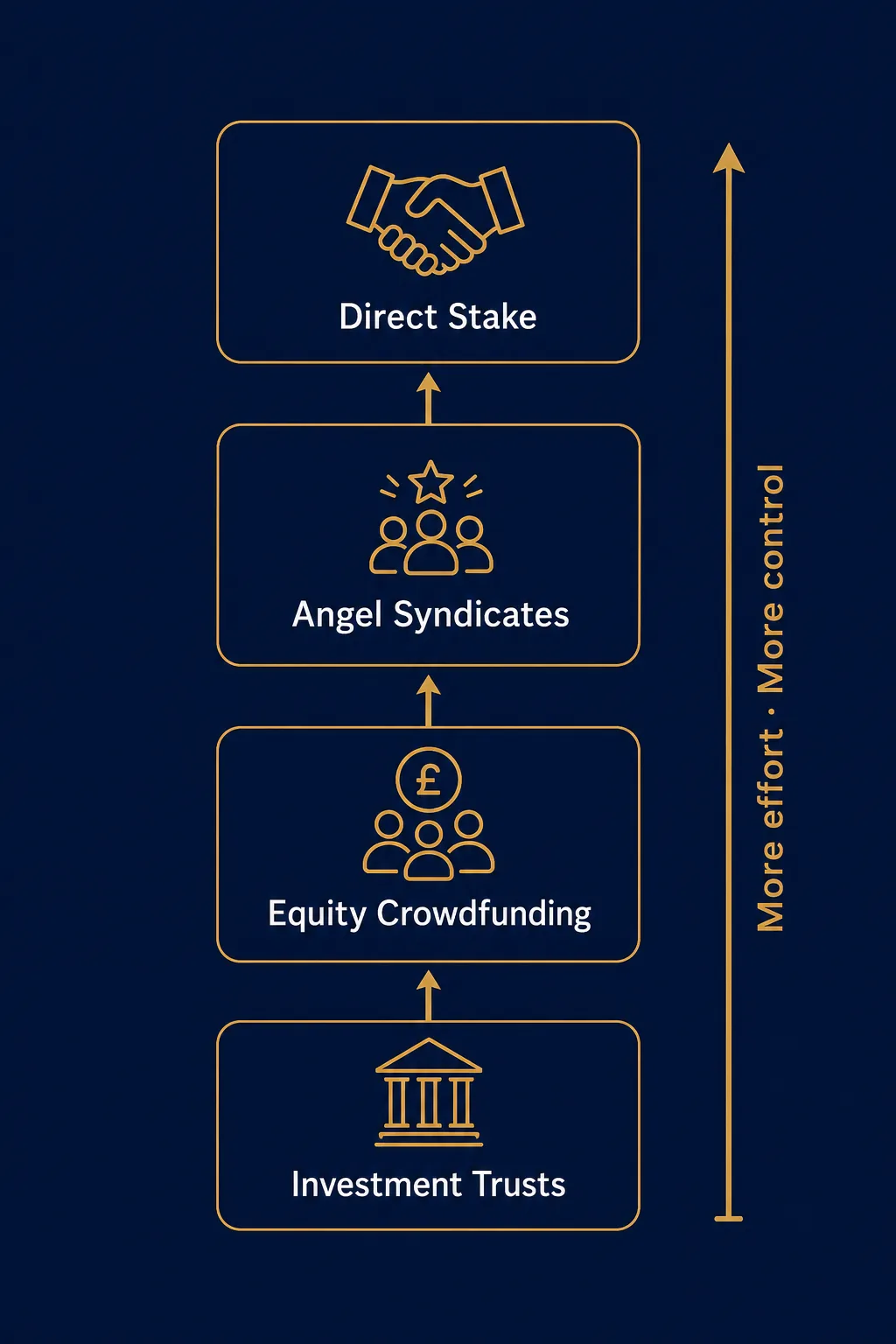
There is no single door into private companies, so the practical way to invest is to match a route to your budget, your appetite for risk, and how hands-on you want to be. The options below run from the lowest-effort wrapper to a direct stake you negotiate yourself. They exist in the numbers they do partly because strong businesses now stay private for longer: ample private capital lets them delay or skip a public listing, a shift government research on the impact of listing on business investment has examined in detail. That is exactly why knowing these routes matters if you want the growth before the float.
Equity crowdfunding platforms
The easiest way to invest a small amount is equity crowdfunding, where many investors pool relatively small tickets into an early-stage company through a single campaign. Platforms such as Crowdcube run these raises, and you invest online: you subscribe to a round, and the shares are usually held through a nominee structure so the company keeps a tidy cap table while you still own the economic stake. Some platforms now host occasional secondary events where you may be able to sell to other members. The appeal is low minimums and access to deals you would never see otherwise; the trade-off is that early-stage failure rates are high and your holding can sit illiquid for years.
Angel investing and syndicates
Angel investing means taking a direct stake in a private company, usually with a larger cheque than crowdfunding and more influence over terms and board matters. In the UK the deals rarely appear on an open platform: they reach you through angel networks and syndicates, where a lead investor sources the opportunity, negotiates the terms, and lets others follow into the same round. That gives you access, but the due diligence burden sits squarely with you, and backing only a handful of names leaves you exposed to real concentration risk.
Investment trusts with private-company exposure
If you want private-company growth without the friction, listed investment trusts are the lowest-effort entry point. Several trusts hold portfolios that include unlisted businesses, and because the trust itself trades on the exchange, you get daily liquidity and professional stock selection inside a familiar wrapper. Watch for discounts and premiums: the trust’s share price can drift below or above the value of its underlying holdings, which affects what you actually pay and receive.
Venture capital, private equity funds and VCTs
Professionally managed funds do the sourcing and diligence for you in exchange for fees and, usually, higher minimums and multi-year lock-ups. Venture Capital Trusts are a UK-specific, listed variant designed to channel money into smaller higher-risk companies, and they come with their own tax treatment. These vehicles suit investors who want exposure to the asset class without picking individual companies themselves.
Dedicated secondary trading platforms
A newer part of the market is made up of venues built specifically to let holders of private shares buy and sell before any IPO. The regulatory landscape here is evolving, including work on intermittent trading venues that would allow private-company shares to change hands during defined trading windows. These platforms can ease the liquidity problem that has always dogged unlisted investing, though the market is still young and you should not assume the depth or reliability of a public exchange.
The tax reliefs that make UK unlisted investing attractive
This is where the UK genuinely stands out, and it is a point the single-angle guides tend to skim. The government offers a set of venture capital schemes, the Enterprise Investment Scheme (EIS), the Seed Enterprise Investment Scheme (SEIS), and Venture Capital Trusts (VCTs), specifically to reward investors who put money into higher-risk private companies. If you are narrowing down which of these routes to use, our guide on choosing between EIS and VCT covers where each one lands in practice. The reliefs available can include income tax relief on the amount invested, favourable capital gains treatment, and loss relief if the investment fails, as set out in HMRC’s guidance on tax relief for investors using venture capital schemes. Anyone deciding where to start usually wants the differences between the two schemes mapped out first, because the company age limits, annual caps and qualifying trades are not the same on each.
These schemes exist because private, early-stage companies struggle to raise capital when the risk is high, so the tax system tips the scales to pull investors in. For anyone deciding how to invest in an unlisted UK company, that changes the maths of the decision: the reliefs soften the blow of the losers and lift your net return on the winners, which is often what makes a single high-risk stake worth taking at all. The rules on eligibility, holding periods, and limits are detailed and change over time, so treat the schemes as a reason to take professional tax advice rather than a set of numbers to memorise here.
Can you invest through a limited company in the UK?
Yes. A UK limited company can hold shares in unlisted companies, and investors sometimes use an investment holding company or a group structure to do exactly that. The main reasons are control over how profits are taxed and reinvested, and, for some, estate or succession planning.
The catch when you invest this way is that many of the personal reliefs above do not pass through to a corporate investor. Schemes like EIS and SEIS are designed for individuals, so a company investing its own money generally cannot claim them, and a corporate holder pays corporation tax on gains and income instead. That makes the limited-company route attractive when you are deploying retained business profits or want a durable investment vehicle, and less attractive when the personal tax reliefs are the whole point. It is a structural decision worth modelling with an accountant before you commit.
How to actually buy: a step-by-step
1. Confirm your investor category. Before you can invest in most private deals, work out whether you qualify as high-net-worth, sophisticated, or restricted, and be ready to self-certify. This determines which deals you can legally be shown. 2. Pick a route. Match the options above to your budget and appetite: trusts for low friction, crowdfunding for small tickets, angel or fund routes for larger, more hands-on commitments. 3. Do your due diligence. Read the financials, understand the cap table and how much you will be diluted in future rounds, look at the board and management, and test whether the product has real traction rather than a good story. 4. Understand the share class and your rights. Ordinary and preference shares behave very differently on an exit. Check tag-along and drag-along provisions, pre-emption rights, and voting rights before you sign. 5. Complete the transaction. Depending on the route, this happens through a platform, via a nominee, or as a direct share purchase completed with a stock transfer form and updates to the company’s register.
The risks nobody puts on the pitch deck
Before you commit to any of these routes, weigh what can go wrong with an unlisted UK holding. The headline risk is illiquidity: you may be unable to sell for years, if at all. Close behind is total-loss risk, since early-stage companies fail often. Valuations are opaque and can be stale, so the number on your statement may not be a price anyone will actually pay. Dilution can quietly shrink your ownership as new rounds close. There is information asymmetry, because founders and lead investors usually know far more than you do. And optimism, or occasionally outright fraud, can make a weak business look strong.
These risks are heaviest in exactly the fast-growing, research-heavy firms that draw most private investors in, the same firms that drive a large share of private-sector innovation, a dynamic explored in the government’s work on private sector R&D investment policies. The way to invest into that risk sensibly is discipline: diversify across many holdings rather than betting on one, and only commit capital you can genuinely lock away and afford to lose.
Getting your money back: exit and selling unlisted shares
Deciding how to invest in an unlisted UK company is only half the job; you also need to know how the money comes back, and that is the part the ranking guides mostly leave out. Because there is no open market, you do not exit by clicking sell. Your capital is returned through a specific event, so the realistic question to ask before you buy is which of those events this particular holding is likely to reach.
When you invest, plan for one of these exit routes: an IPO, where the company floats and your shares become publicly tradeable; a trade sale or acquisition, where a larger buyer takes over; a secondary sale, where you sell your stake privately to another investor; a company buyback of its own shares; or, for fund holdings, the wind-down of the fund at the end of its life. The emerging secondary platforms and intermittent trading venues mentioned earlier are slowly making private secondary sales more feasible, but they do not yet offer anything like everyday liquidity.
Set expectations in years, not months. A holding period of five to ten years is common, and finding a buyer for a private stake can take time and often means accepting a discount.
So decide how you will exit before you invest, not after you want out: knowing which route is plausible, and how long it is likely to take, is part of judging whether the investment is worth making in the first place.
What about buying unlisted shares abroad?
Some searchers arrive comparing the UK with overseas markets, and the honest answer is that the mechanics differ by country. In India, for example, there are established dealer networks and platforms that trade unlisted shares and pre-IPO stock, and the question of where to buy unlisted shares in India usually points to those specialist intermediaries. But the tax treatment, settlement, and investor protections are not the UK’s, and a UK-based investor buying overseas private shares takes on extra layers of cross-border regulation, currency risk, and compliance. Unless you have a specific reason and good local advice, the UK routes and the reliefs attached to them will usually be the cleaner path.
Frequently asked questions
What is the 7% sell rule?
How much do I need to invest to make £1,000 a month in the UK?
Can you invest in unlisted companies with a small amount?
Are unlisted shares regulated?
Where this leaves you
Unlisted investing rewards patience, diligence, and diversification more than timing or flair. Choose the route that fits your eligibility and appetite, from a low-friction investment trust to a hands-on angel stake; use the venture capital tax reliefs the UK offers to improve your net position; and decide how you will exit before you put a penny in. Much of the edge in private markets comes from access and shared scrutiny, which is where a vetted network of experienced investors earns its keep, giving you better deal flow and more eyes on the due diligence than you would ever manage alone.