
A private company has no share price ticking on a screen. The number in the pitch deck is a claim, not a fact, and the person making it usually stands to gain from it. Before you commit capital, you need a way to pressure-test that figure. This is the pricing companion to our look at the real risks and returns of investing in private companies: once you’ve decided the asset class is right for you, valuation is how you judge whether a specific deal is fairly priced.
Why private companies are harder to value than public ones
A listed company reports on a fixed schedule, trades in a liquid market, and has a price set by thousands of participants. A private company has none of that. Financials may be thin, self-reported, or built on optimistic projections, and there is no obligation to disclose. As the NYU Stern research on valuing private firms sets out, the combination of limited information and illiquidity means the output is an estimate within a range, never a single hard number.
That changes the goal. You are not hunting for the “true” value. You are building a defensible range and buying with a margin of safety inside it. That is why professionals lean on three approaches, then adjust for the things that make private stakes different.
The three ways to value a company
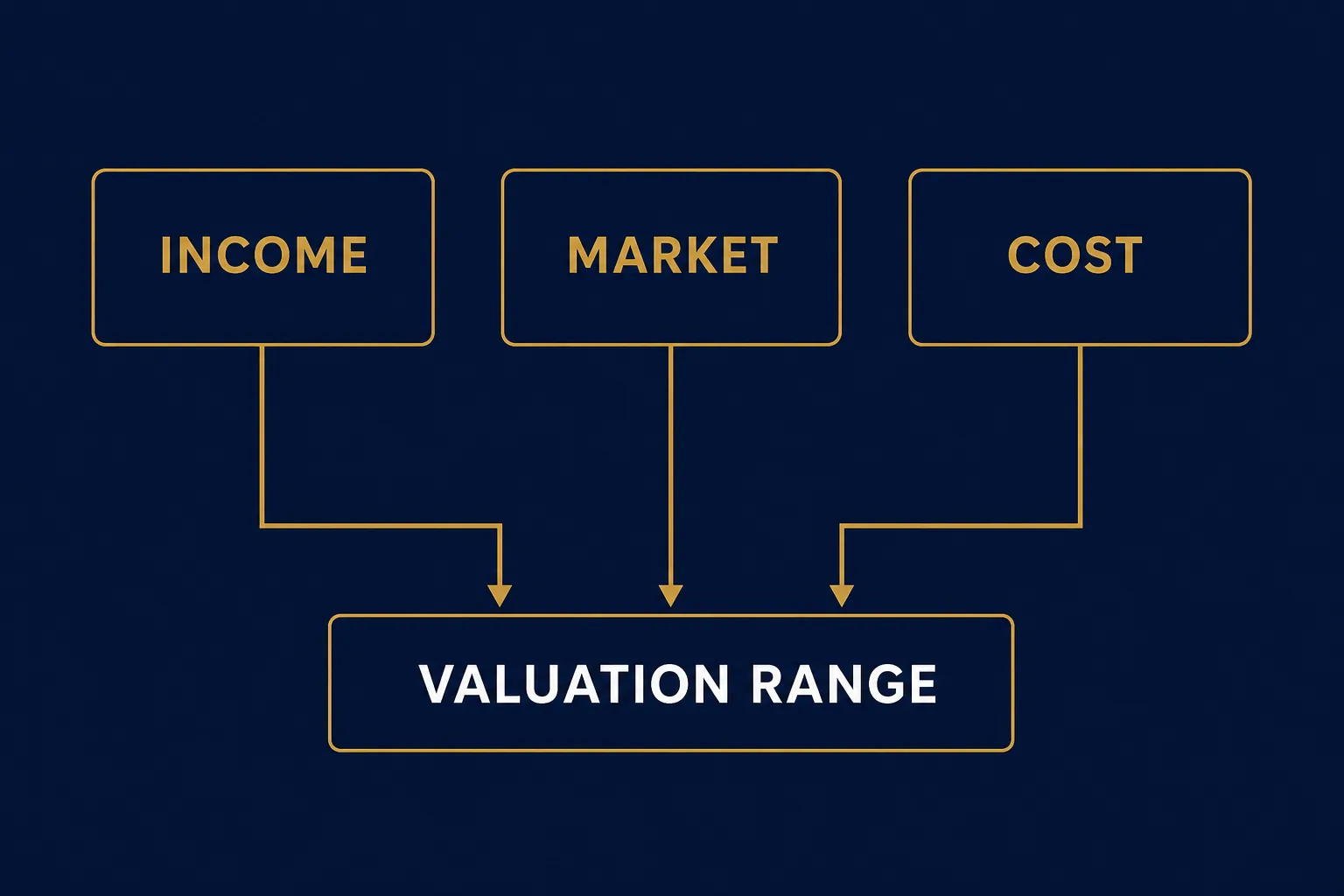
Investment bankers and appraisers triangulate across income, market, and cost. No single method is authoritative; each checks the others.
| Approach | What it measures | Best fit | Weakness |
|---|---|---|---|
| Income (DCF) | Present value of future cash the business will generate, discounted for time and risk | A mature, cash-generating company | Highly sensitive: small changes to growth or discount-rate assumptions swing the answer dramatically |
| Market (comparables and multiples) | The target priced against comparable public companies and precedent transactions, using EV/EBITDA, revenue multiples and similar ratios | Quick, real-price-grounded checks | Comparables are rarely perfect matches, and a private firm should trade below its public peers |
| Cost or asset | Net assets: what you would pay to rebuild it, or recover in a wind-down | Asset-heavy or distressed businesses | Badly understates growth and IP-driven companies, where most value sits in future earnings, not the balance sheet |
Income approach (discounted cash flow)
A DCF values the business as the present value of the cash it will generate in future, discounted for time and risk. It is the most theoretically sound method and the best fit for a mature, cash-generating company. Its weakness is sensitivity: small changes to growth or discount-rate assumptions swing the answer dramatically, so always demand the inputs behind any DCF handed to you.
Market approach (comparables and multiples)
Here you price the target against comparable public companies and precedent transactions. This is where private company valuation multiples come from: EV/EBITDA, revenue multiples, and similar ratios applied to the target’s own figures. It is quick and grounded in real prices, but the comparables are rarely perfect matches, and a private firm should trade below its public peers.
Cost or asset approach
This values the company at its net assets: what you would pay to rebuild it, or recover in a wind-down. It suits asset-heavy or distressed businesses. It badly understates growth and IP-driven companies, where most of the value sits in future earnings, not the balance sheet.
Two main methods I would use at that company size would be 1) asset valuation 2) EBITDA multiple. Best to do both and see which one is higher.
How to value a private company based on revenue

When a company has little or no profit, earnings-based methods break down, so early-stage and high-growth firms are often priced on a revenue multiple. That multiple reflects growth rate, gross margin, and how durable the revenue is.
This is also where the familiar “is a business worth three times profit?” rule needs care. A roughly 3x earnings multiple is a broker’s shorthand for small, stable, owner-run businesses, and it varies widely by sector, growth, and margin quality. A fast-growing software firm can command far more; a declining one, far less. Treat it as a conversation-starter, never a valuation.
Valuation calculators and the 409A
Online private company valuation calculators are fine for a rough sanity-check. They cannot capture customer concentration, the quality of the management team, or the assumptions hiding inside a projection, so they are no substitute for real diligence.
A 409A valuation is a US independent appraisal of the fair market value of a company’s common stock, used to set option strike prices. It is a useful third-party reference point, but it is produced for a tax and compliance purpose, and it typically values common stock rather than the preferred equity an investor buys in a priced round. Use it as one data point, not the price.
The discounts that quietly change the number
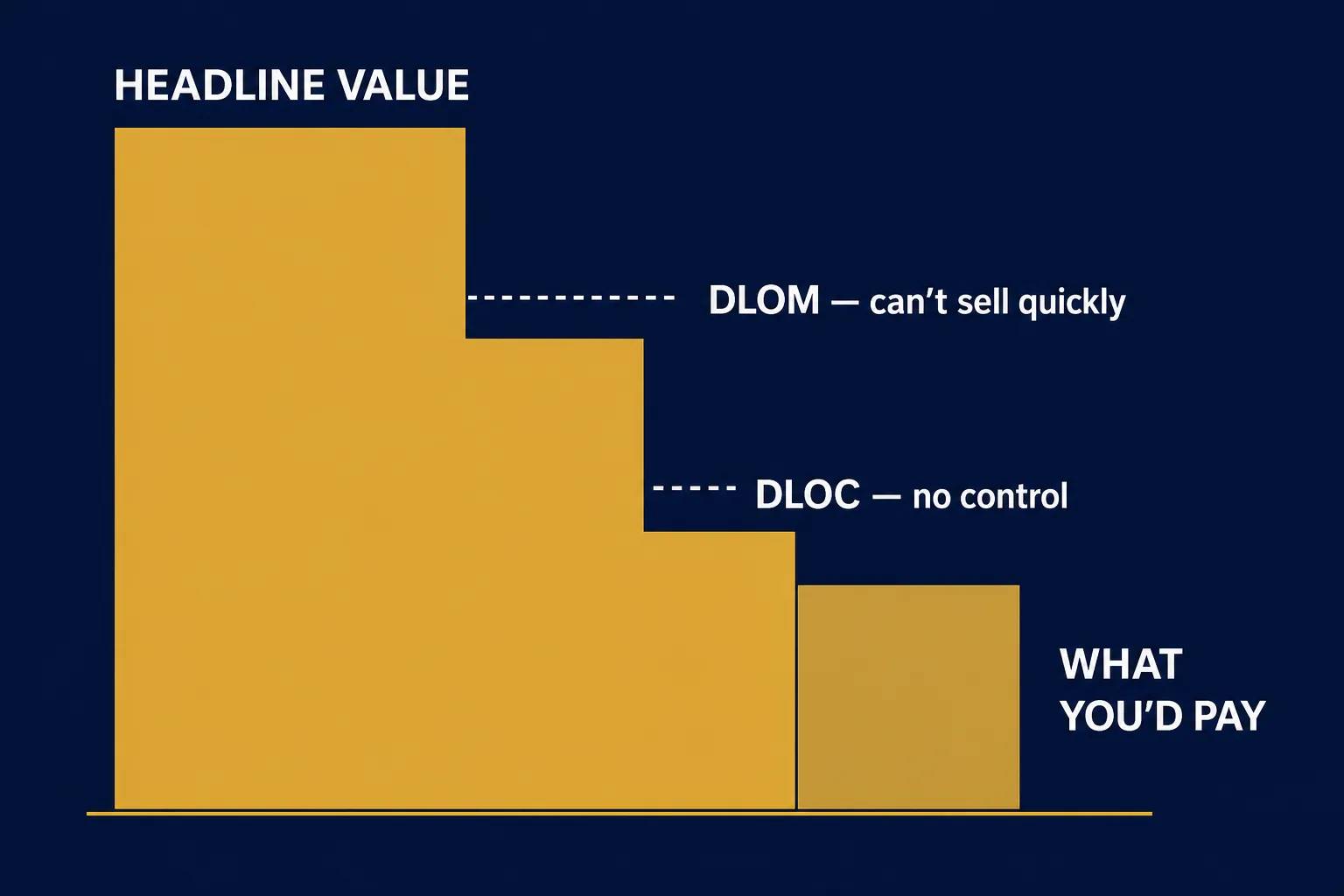
Two adjustments routinely move the headline figure, and top-line valuations often skip them. The discount for lack of marketability (DLOM) reflects that you cannot sell a private stake quickly or cheaply. The discount for lack of control (DLOC) reflects that a minority holder cannot direct strategy, dividends, or an exit. The NYU Stern analysis notes that illiquidity alone can reduce private-firm value materially. If you are a passive minority investor, expect both discounts to apply, and be wary of any pitch that ignores them.
From company value to the value of your shares
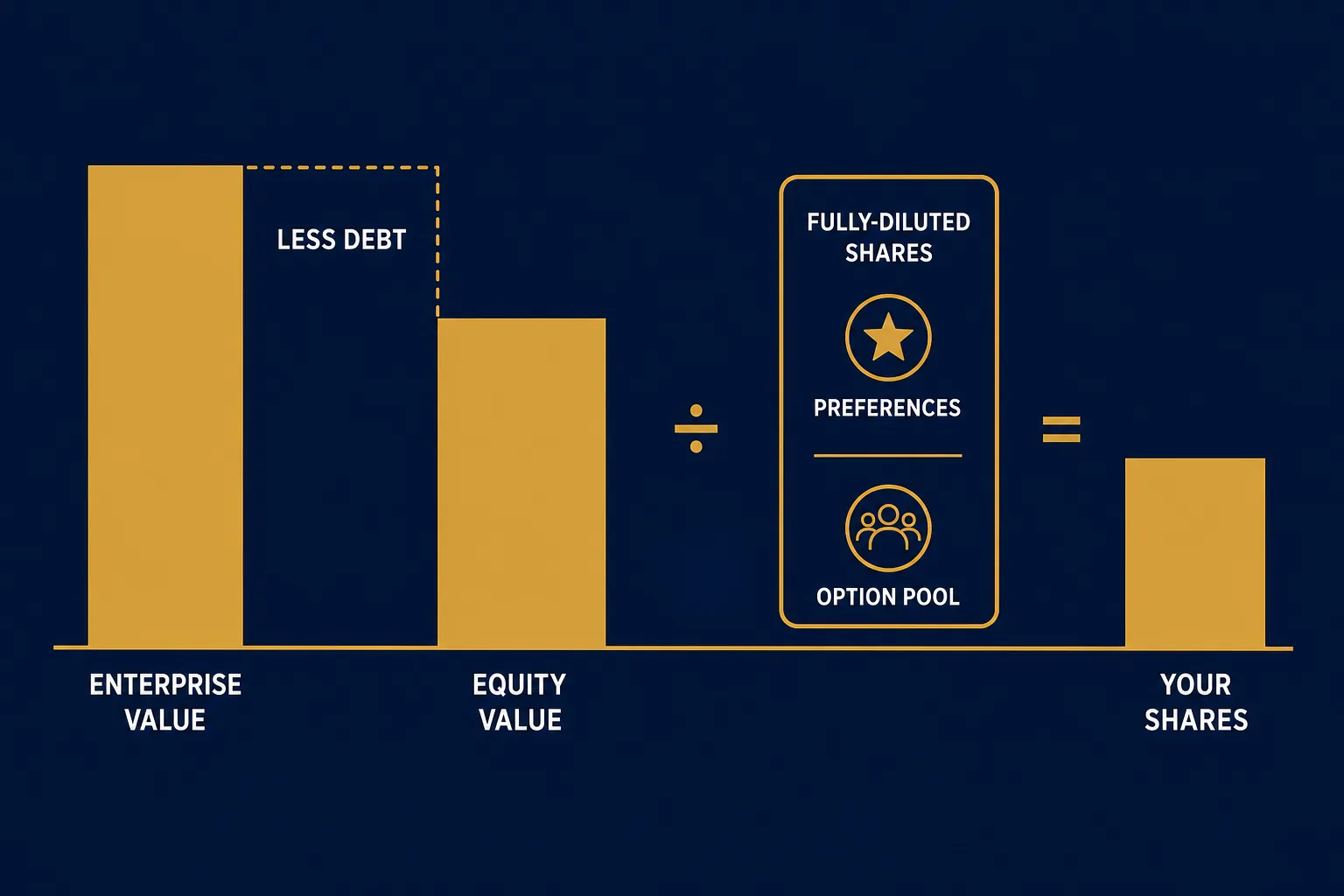
A company’s enterprise value is not what your shares are worth. Strip out debt to get equity value, then divide by the fully-diluted share count, not just the shares outstanding today. Liquidation preferences can pay preferred holders first, the option pool dilutes everyone, and future rounds dilute you again. Two investors can buy at the same headline valuation and own very different economic stakes. Once you’ve settled on a price per share, how you actually buy shares in a private company is the next practical step.
Two investors can buy at the same headline valuation and own very different economic stakes.
The 80/20 rule: price like a portfolio, not a single bet
The 80/20 rule in private equity is the observation that a large share of total returns tends to come from a small share of investments. Value creation is concentrated in a few winners. That has a direct bearing on valuation: because returns are so skewed, no single pricing error should sink you, provided you are diversified and disciplined. The aim is sound pricing across a portfolio, not flawless precision on one deal.
A pre-investment valuation checklist
- Cross-check the price with at least two of the three approaches.
- Verify the actual numbers behind any multiple; don’t accept the multiple alone.
- Apply illiquidity and minority discounts to any headline figure.
- Model dilution on a fully-diluted basis, including the option pool.
- Demand the assumptions behind any DCF and stress-test them.
- Treat every figure, whether from a calculator, a 409A, or the founder, as one data point among several.
This is the discipline that separates a considered commitment from a leap of faith.
Frequently asked questions
What is the best way to value a private company?
How do you value a company before investing?
Is a business worth three times profit?
What is the 80/20 rule in private equity?
A valuation you can defend beats a valuation that flatters the deal. The disciplined investor prices the stake before committing to it, not after.