
Private markets are open to more individual investors than ever, and the return potential is genuine. But the risk profile is not a higher-octane version of owning public stocks; it is a different animal. Your capital can be locked up for years, there is no daily price to check, and much of what you would want to know about a business is never disclosed. This guide lays out the major risk categories of investing in private companies, explains why private equity is so often controversial, and sets out a practical framework for managing the downside, so you can judge whether these investments belong in your portfolio at all.
Private companies vs. public markets: why the risks are different
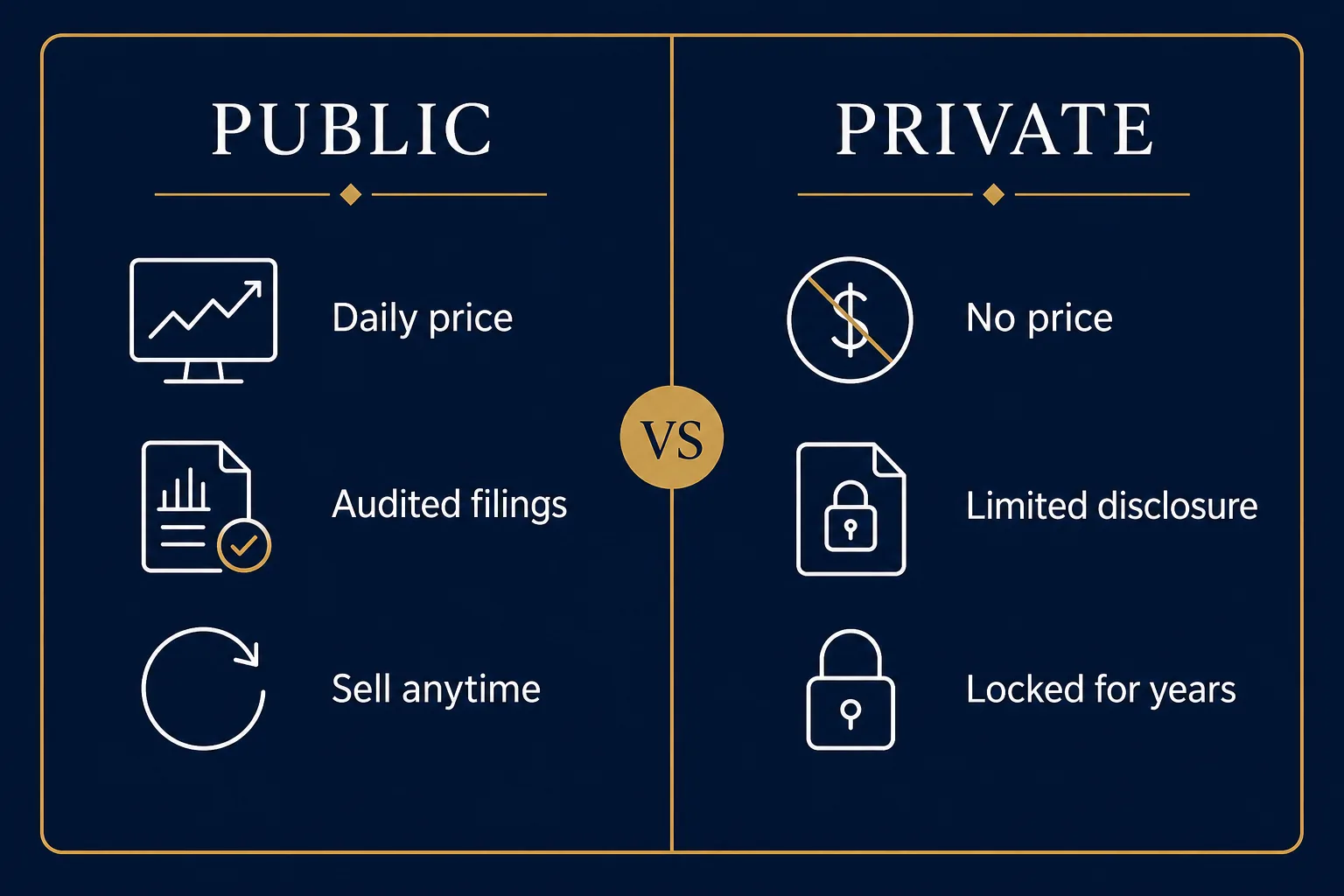
A public company comes wrapped in guardrails: audited quarterly filings, a share price that updates by the second, analysts picking apart every number, and an exit that is one click away. A private company has none of that. There is no mandatory public disclosure, no continuous market price, and no liquid way out when you change your mind.
Those structural gaps change more than convenience. They change behaviour and outcomes. Research on the differences between public and private firms finds that private companies invest and respond to opportunities differently from their listed peers, partly because they are insulated from public-market scrutiny and short-term price pressure. That insulation can be a feature (managers take a longer view) or a hazard (problems stay hidden longer). Either way, the instincts that serve you in public markets, such as reading the daily tape or trimming a position on bad news, do not transfer.
If you are new to the category, the vocabulary helps. “Private equity” broadly covers investing in companies that are not listed on a stock exchange, whether through venture capital in early-stage startups, growth equity, or buyouts of mature businesses. Most individuals access it not by buying a single company directly but through a fund run by a general partner (GP), who pools capital from limited partners (the investors) and deploys it over several years. How you get in matters, because it shapes almost every risk that follows.
The main risks of investing in private companies
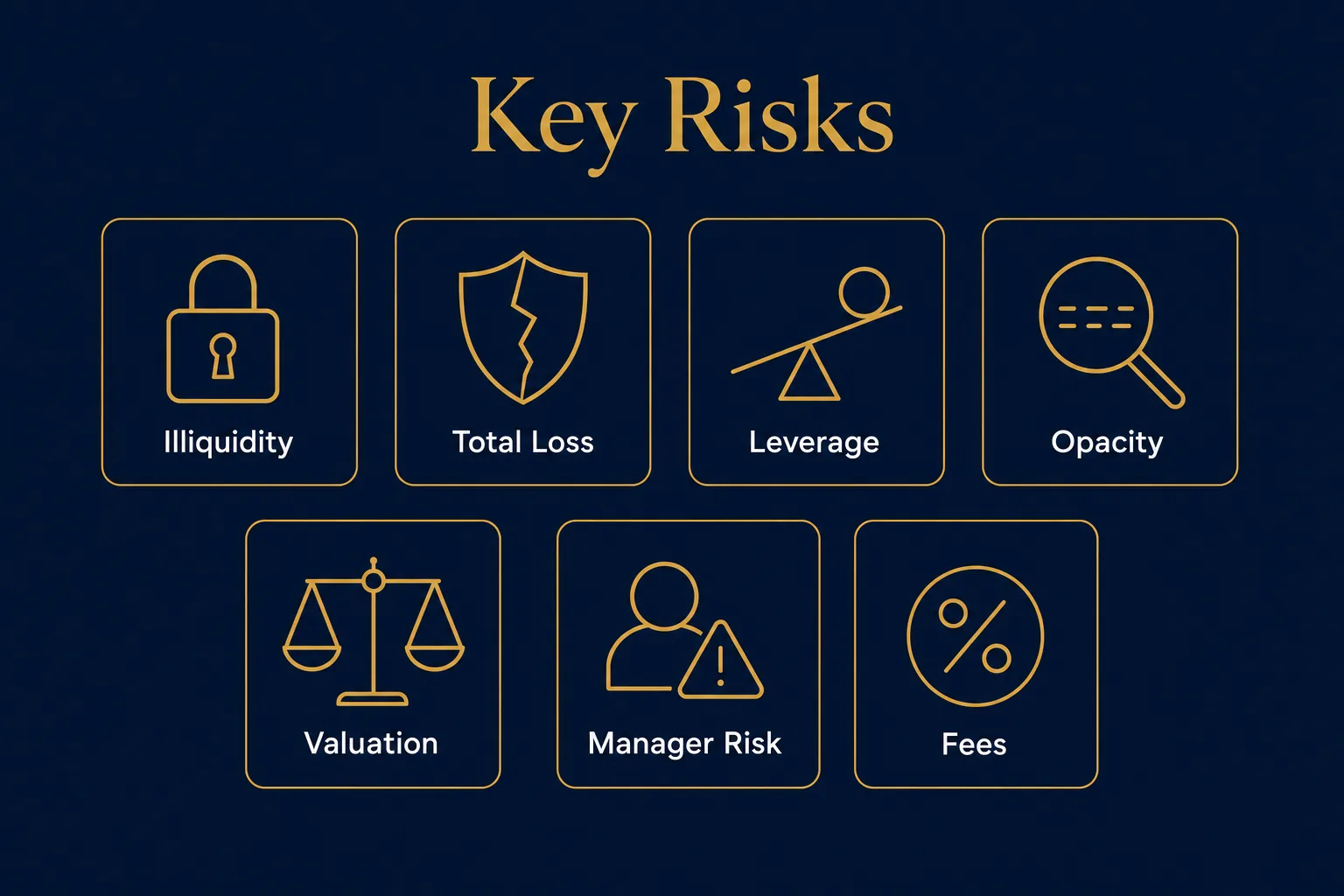
Illiquidity: your money is locked up
This is the defining risk. When you commit to a private fund or a direct deal, you are typically agreeing to leave that capital in place for the better part of a decade. There is no ready secondary market to sell into, and the discounts on the secondary markets that do exist can be steep. Funds also draw your money through capital calls over time, so you must keep committed cash available on the GP’s schedule, not yours. If your circumstances change, the investment usually will not flex with them.
Risk of total loss
Private investments carry a high degree of risk and can result in a partial or complete loss of the capital you put in. This is not a theoretical footnote. Early-stage companies fail at high rates, and even an established business bought in a leveraged deal can be wiped out if the plan does not work. Unlike a diversified index fund, a single private position can genuinely go to zero.
Leverage and debt fragility
Many private equity deals, particularly buyouts, load the acquired company with significant debt. Leverage magnifies returns when things go well and magnifies losses when they do not. Interest must be serviced through good years and bad, and a business that would survive comfortably unlevered can be pushed into distress when a heavy debt load meets a downturn or a rate spike. Analysis from the University of Chicago Business Law Review documents how over-leverage can leave portfolio companies fragile, so that a modest shock becomes an existential one. As an equity holder, you sit last in line if that happens.
Lack of transparency and information asymmetry
You are largely dependent on what the GP chooses to tell you. Reporting is periodic rather than continuous, the detail is thinner than a public filing, and you rarely see the granular operating data behind a valuation. The people running the deal know far more than the people funding it, and that asymmetry persists for the life of the investment.
Valuation uncertainty
With no market price, private holdings are carried at an estimated net asset value (NAV) that the manager reports periodically. Those marks tend to move smoothly, which can make a portfolio look less volatile than it truly is. The calm is partly an accounting artefact: the underlying business may be swinging far more than the reported figures suggest, and the true value only becomes clear at an exit that may be years away.
Manager and execution risk
In public markets, most of your return comes from the market itself. In private markets, it comes overwhelmingly from the specific manager you chose. The gap between the best and worst funds is wide, so picking well is not a nicety, it is the whole game. A Harvard Business School analysis of the case for private equity examines how net-of-fee returns and the persistence of manager skill have shifted as the industry has grown, a reminder that yesterday’s star fund is no guarantee of tomorrow’s. Back the wrong GP and even a strong vintage year will not save you.
Fees and their drag on returns
Private funds are expensive. The classic “2 and 20” structure, roughly a 2% annual management fee plus 20% of the profits (carried interest), takes a meaningful bite out of gross returns before you see a penny. Fees compound against you over a multi-year hold, which is why net-of-fee performance, not the headline gross figure, is the number that matters.
Concentration and diversification challenges
High minimum commitments make it hard for smaller investors to spread risk the way they would with public stocks. If a single fund requires a large cheque, you may end up with just one or two positions rather than a diversified book, leaving you exposed to the fortunes of a handful of companies or a single manager’s judgement.
| Dimension | Public markets | Private companies |
|---|---|---|
| Liquidity | Liquid, an exit is one click away | Illiquid, capital locked up for the better part of a decade |
| Pricing | Priced daily, a share price that updates by the second | Valued by periodic estimates (NAV) reported by the manager |
| Disclosure | Heavily disclosed, audited quarterly filings and analyst scrutiny | Thinly disclosed, no mandatory public disclosure |
| Leverage | Varies | Often leveraged, particularly in buyouts |
| Source of return | Mostly the market itself | Overwhelmingly the specific manager you chose |
Private credit: a fast-growing risk to understand
One risk the standard guides barely mention is private credit, now one of the largest and fastest-growing corners of private markets. Instead of buying equity, investors lend directly to companies, often mid-sized borrowers that banks have stepped back from, usually at floating rates and with less public information than a bond investor would get.
The appeal is steady income and higher yields. The risks are real: borrower default, exposure to rising rates that squeeze already-leveraged companies, and the simple fact that much of this market has not been tested through a severe, prolonged downturn. The Federal Reserve’s analysis of private credit sets out how the sector’s opacity and rapid growth create vulnerabilities that investors and regulators are still coming to understand. If a private credit allocation is on your table, treat it as its own risk category, not a bond substitute.
Why private equity is controversial: the societal and reputational angle
Ask whether private equity is bad for society and you will get strong opinions on both sides. The criticism is worth understanding, because it points to real risks in how some deals are run. The core critique is that the model’s pressure for short-term profit can transmit harm to third parties: patients when the target is a hospital or nursing home, workers when cost-cutting follows an acquisition, and unsecured creditors when a heavily indebted company fails. Rather than repeat any specific list of “companies ruined by private equity,” the honest point is the pattern: aggressive leverage and rapid margin extraction can leave a business, and the people who depend on it, worse off.
There is also a systemic worry as private markets open to a broader base of investors. Research from Stanford’s Institute for Economic Policy Research warns that the “democratization” of private equity, pushing these illiquid, leveraged strategies toward everyday investors, could concentrate risk in ways that create fragility across the wider financial system.
The fairer picture includes the other side. Private capital funds growth for companies that cannot or will not tap public markets, backs innovation that public shareholders might punish, and, in the best cases, brings operational discipline that genuinely makes businesses more valuable and more productive. At its best, private equity aligns patient capital with long-term value creation. It stays controversial because at its worst the same tools that build value can be used to extract it. Both are true, and a serious investor holds both in view.
It stays controversial because at its worst the same tools that build value can be used to extract it.
Is it safe to invest in a private company?
No private investment is “safe” in the sense of protecting your capital the way an insured deposit or a short-term government bond does. You can lose part or all of what you commit, and you cannot easily get out. What private investing can be is suitable, for the right investor. Suitability turns on a few honest questions. Is your time horizon long enough to leave the money untouched for many years? Can you meet capital calls without straining your finances? Do you qualify as an accredited or professional investor? And can you diversify across enough positions that a single failure will not derail you? If the answers are yes, the risk becomes something you carry deliberately rather than stumble into.
Private equity risk management: how investors reduce the downside
The risks above are real, but they are not random. Experienced investors manage them with a repeatable discipline.
Due diligence: the elements to evaluate
Before committing, work through the fundamentals of the offering. Understand the purpose (why is this capital being raised, and does the use of funds make sense?), the issuer (who is running this, and what is their track record and integrity?), the security (what exactly are you buying, equity, debt, or a fund interest, and what rights does it carry?), repayment or return (how and when does money actually come back to you?), and finally an honest risk assessment of what could break the thesis. Skipping any one of these is how investors get surprised.
Diversification across managers, vintages, and sectors
Because manager risk dominates, spreading commitments across several GPs, multiple vintage years, and different sectors is one of the most effective ways to reduce the chance that any single failure or bad market timing dominates your outcome. For many individuals, a fund-of-funds or a diversified access vehicle is the practical route to that breadth, trading a layer of fees for meaningfully lower single-manager risk.
Position sizing and liquidity planning
Only commit capital you can genuinely afford to lock up. Size private allocations as a considered slice of a broader portfolio, keep enough liquid assets on hand to meet capital calls and life’s surprises, and never let an illiquid commitment force you to sell other holdings at the wrong moment.
Matching risk to your investor profile
The right amount of private-market exposure depends on who you are: your horizon, your income stability, your tolerance for opacity, and your access to good deal flow. This is where working alongside a knowledgeable, member-based network of investors can help, giving you vetted opportunities, shared due diligence, and the perspective of experienced co-investors rather than going it alone. The goal is not to chase every deal but to match the ones you do back to your own situation.
Frequently asked questions
Is it safe to invest in a private company?
What is the biggest risk of private equity?
How is private company risk different from stock market risk?
Can you lose all your money in private equity?
How much of a portfolio should be in private markets?
The risks of investing in private companies are real and specific: illiquidity, the chance of total loss, debt-driven fragility, opacity, valuation uncertainty, fees, and heavy dependence on the manager you pick. None of them is a reason to avoid the category outright, and none is a mystery. Each can be assessed, sized, and diversified against. Investors who go in with clear eyes, match these commitments to a long horizon, and lean on solid due diligence and a well-informed network are the ones best placed to capture the upside that drew them to private markets in the first place.