
Early-stage investing used to sit behind a velvet rope. Backing a private company before it went public was reserved for venture funds, family offices, and people who already had serious money. Regulation changed that. An ordinary person can now put a few hundred dollars into a young company through the same kinds of online platforms professionals use. This guide covers the parts that matter for a first-timer: whether you are allowed to invest, where you do it, how little you can start with, how to size up a deal, and how to manage risk so a bad bet does not wreck you.
Can a Normal Person Really Invest in Startups?
Yes. For most of the last century, buying shares in a private startup meant being an accredited investor. Equity crowdfunding rules, known in the United States as Regulation Crowdfunding (Reg CF), changed that by letting non-accredited investors buy stakes in early-stage companies through registered online platforms. These deals happen online through an SEC-registered intermediary, and everyday investors can take part within set limits.
It helps to know where you fall. An accredited investor is broadly someone who earned more than $200,000 a year (or $300,000 with a spouse) in the last two years, or holds a net worth above $1 million excluding their primary home. Meet that bar and more doors open, including venture funds and larger private deals. If you do not, you can still invest through crowdfunding platforms, with annual caps tied to your income and net worth.
One honest caveat: access is not the same as easy money. Being allowed to invest in startups does not make you good at it. Most startups fail, and many of the companies raising money are years away from proving they work. Treat this as a skill to build slowly, not a shortcut.
Understand the Risk Before You Invest a Dollar

Startup investing has a very different shape from buying an index fund. Three features define it, and each one deserves a moment of your attention.
It is high-risk. The base rate of failure is brutal, and a large share of early-stage companies return nothing. Returns follow a power law: a small number of big winners tend to carry an entire portfolio while the rest go to zero or close to it. Research summarized by ESADE’s Do Better underlines the trade-off. The asset class drives real innovation and can deliver outsized returns, but the risk of loss on any single company is significant.
It is illiquid. A public stock sells in seconds. A startup investment usually has no easy resale market, and your capital may be locked up for years. Assume you cannot get the money back until the company is acquired, goes public, or, more often, quietly winds down.
It is long-horizon. A successful startup can take five to ten years to reach an exit, if it ever does. Patience is not optional.
The practical rule follows directly: only invest money you can afford to lose entirely. This is not where your emergency fund, your rent, or next year’s tuition belongs.
If losing the whole amount would change how you live, the amount is too big.
How Much Money Do You Need to Start?

One of the biggest myths is that you need tens of thousands of dollars to get in the door. You do not. Many equity crowdfunding platforms set minimums as low as $50 or $100 per deal, so the real question is not “can I afford one company” but “how do I spread a modest budget across several.”
Think about your budget as a percentage of your investable assets rather than a headline dollar figure. Many people cap their entire startup allocation at a small slice of their overall portfolio, precisely because the loss rate is so high. Within that slice, write many small checks instead of one large one. Ten $100 investments across ten companies gives you a far healthier risk profile than a single $1,000 bet on your favorite founder.
The annual limits that apply to non-accredited investors are worth respecting for their own sake. They scale with your income and net worth, and they exist to stop people from overexposing themselves to a risky asset class. Two habits protect budget-conscious beginners more than anything else: do not invest money you will need soon, and do not let one exciting pitch talk you into oversizing.
Where to Invest in Startups: The Main Routes
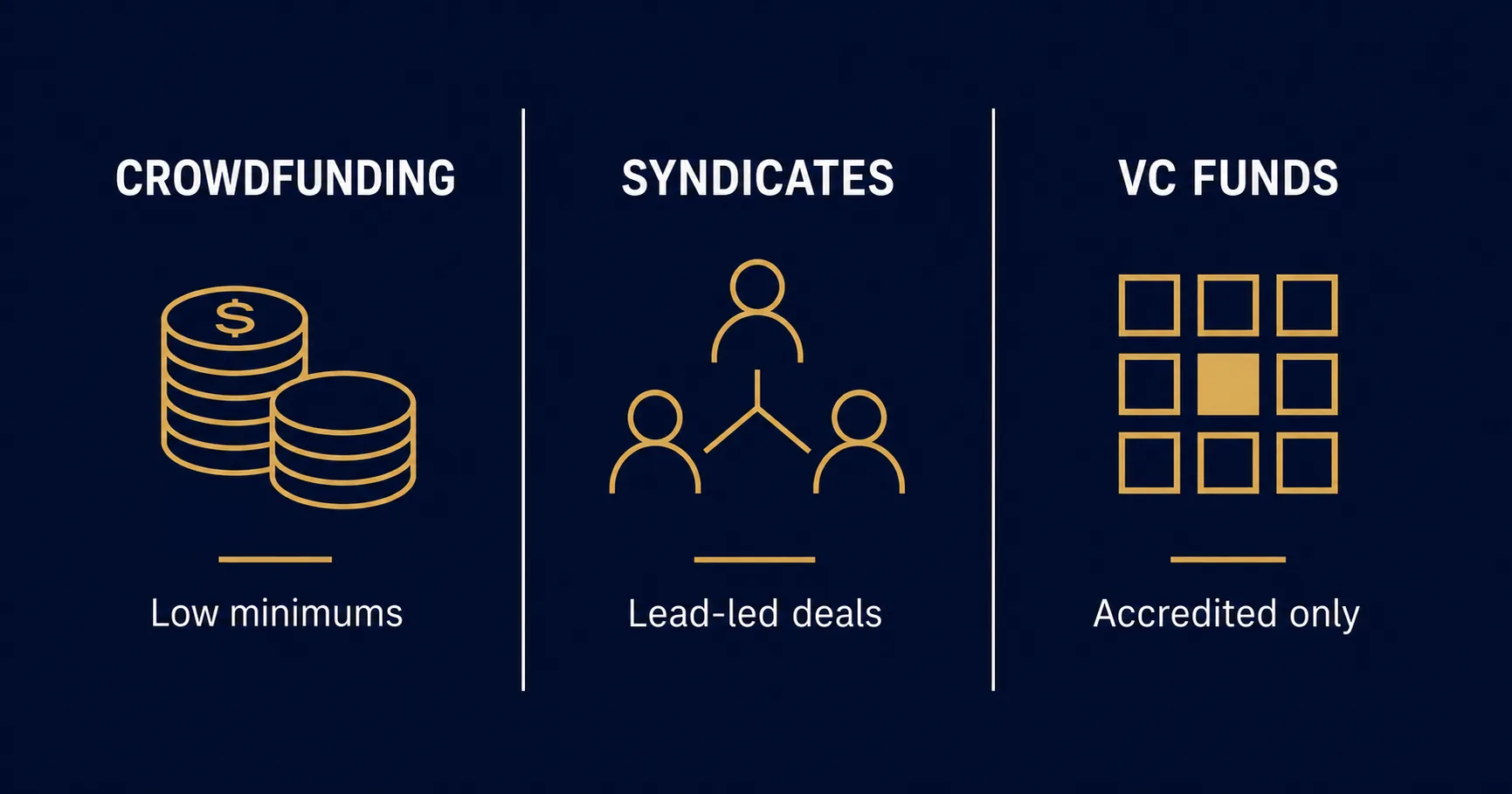
There is no single “startup market.” There are several distinct routes in, each with its own minimums, level of hand-holding, and risk. Here are the ones a beginner will actually encounter.
| Route | Who it suits | What to know |
|---|---|---|
| Equity crowdfunding platforms | Non-accredited beginners | Lowest minimums; you pick companies and read disclosures yourself |
| Angel networks and syndicates | Beginners who want an experienced lead | Higher minimums; many syndicates expect accredited investors |
| Venture capital and rolling funds | Accredited investors wanting diversification | Professional management, but high minimums and long lock-ups |
| Direct investing in founders | Those with real access and high risk tolerance | Most control and earliest access, most concentrated risk |
Equity Crowdfunding Platforms
This is the most common entry point for non-accredited beginners. The flow is straightforward: create an account, browse open deals, read each company’s disclosures and financials, and invest online in a few clicks. After that you hold the shares and wait. These platforms handle the paperwork and the regulatory intermediary role, so your job is mostly picking companies and reading carefully. The better sites are transparent about fees, show full company disclosures, and are registered with the relevant regulator. Look for those signals before you fund anything.
Angel Networks and Syndicates
Angel investing means backing very early companies, often before they have meaningful revenue. Rather than going it alone, many beginners join a syndicate, where a lead investor sources the deal and does the due diligence and everyone else invests alongside them on the same terms. You are pooling money and, more importantly, borrowing the judgment of someone with more experience. Minimums are usually higher than crowdfunding, and many syndicates expect accredited investors.
Venture Capital Funds and Rolling Funds
If you are accredited and want diversification without picking individual companies, a venture fund spreads your money across a portfolio the managers select. Rolling funds work similarly on a subscription basis. You get professional management and built-in diversification, but minimums are higher and your capital is locked up for the life of the fund.
Direct Investing in Founders and Local Startups
The highest-touch, highest-risk route is investing directly in a company you know, whether a friend’s startup or a local business raising a round. This gives you the most control and often the earliest access, but it also carries the most concentrated risk and the least protection. One variation worth knowing: some investors advise a founder for free early on, build genuine goodwill, and later formalize an advisory arrangement that can include a small equity stake. Done honestly, it earns a position through contribution rather than cash. Whatever the structure, get the terms in writing.
How to Evaluate a Startup Before Investing
Most beginner guides go thin here, which is a shame, because evaluation is where you actually protect your money. You will never have perfect information about an early-stage company, but you can be systematic.
Start with the team. At the earliest stages you are betting on people more than on numbers. Good startup investors get better than the market at recognizing exceptional founders early. Ask whether these specific people are unusually capable of building this specific thing, and whether they can attract talent and capital.
Then the market. How big is the problem, and how many people or businesses feel it badly enough to pay? A great team in a tiny market has a low ceiling.
Then traction and economics. Is anyone using the product? Is there revenue, and does the unit economics suggest the company can eventually make money on each customer? Early traction is not proof, but its total absence is a warning.
Then the terms. Understand the valuation you are buying in at, how much dilution future rounds will cause, and what your shares actually entitle you to. A brilliant company at an absurd valuation can still be a poor investment.
Finally, the red flags. Be wary of no clear path to revenue, opaque or incomplete disclosures, and hockey-stick projections with no basis. Read the company’s offering documents closely; those filings are your primary tool for diligence.
Build a Portfolio, Not a Bet
Because returns follow a power law, the single most important habit for a beginner is diversification. You cannot reliably predict which company will be the winner, so you buy enough shots on goal that catching one is realistic.
In practice, spread your allocation across many startups rather than concentrating it. A common approach is to invest small amounts across ten, twenty, or more companies over time instead of committing everything at once. Investing gradually also spreads you across different market conditions and keeps you from going all-in during a hype cycle.
Set your expectations accordingly. Most of your companies will return little or nothing. A few may do fine. The math of this asset class only works if you hold enough positions that one strong outcome can outweigh the many that fail. Reinvest what you can, stay patient, and measure your results over years, not months.
A Simple Step-by-Step to Make Your First Investment
- Confirm your status and set a budget you can lose. Work out whether you are accredited, note any applicable limits, and decide on a total startup allocation that would not hurt if it went to zero.
- Choose a reputable platform or network. Favor registered, transparent platforms or a syndicate with an experienced lead. Check fees and read the fine print.
- Read the disclosures and diligence the deal. Go through the team, market, traction, and terms. If anything is unclear or hidden, treat that as a reason to pass.
- Start small and spread it out. Make your first check a small one, and plan to invest across several companies rather than concentrating.
- Track your holdings and plan for a long hold. Keep a simple record, expect illiquidity, and give each investment years to play out.
Frequently asked questions
Can a beginner invest in startups with little money?
What are the best sites to invest in startups?
How risky is startup investing?
How long until I see returns?
Can I invest in startups if I’m not accredited?
Getting Started the Right Way
Startup investing rewards patience, diversification, and disciplined diligence far more than enthusiasm for any one pitch. Start small, spread your capital across many companies, read every disclosure, and treat the money as genuinely at risk. That measured approach is the mindset that a members’ community like Beaufort Society is built around, giving members a considered way into vetted private-market deals. Take the first step deliberately, and let time and diversification do the heavy lifting.