
Private companies are not listed on a public exchange, so you cannot buy a stake with a tap in a share-dealing app. Access runs through funds, platforms, syndicates and tax-advantaged schemes, and some routes are gated by your investor status. This guide sets out the practical options for UK-based individual investors, whether you have a few hundred pounds or a portfolio ready for direct deals, plus the rules and risks that decide which routes are open to you.
What is private equity, and how does it differ from public investing?
Private equity is capital invested directly into companies that are not traded on a stock market. Instead of buying shares that change hands daily, investors commit money to a company or a fund that takes ownership stakes, aiming to grow the business and exit later through a sale or a public listing.
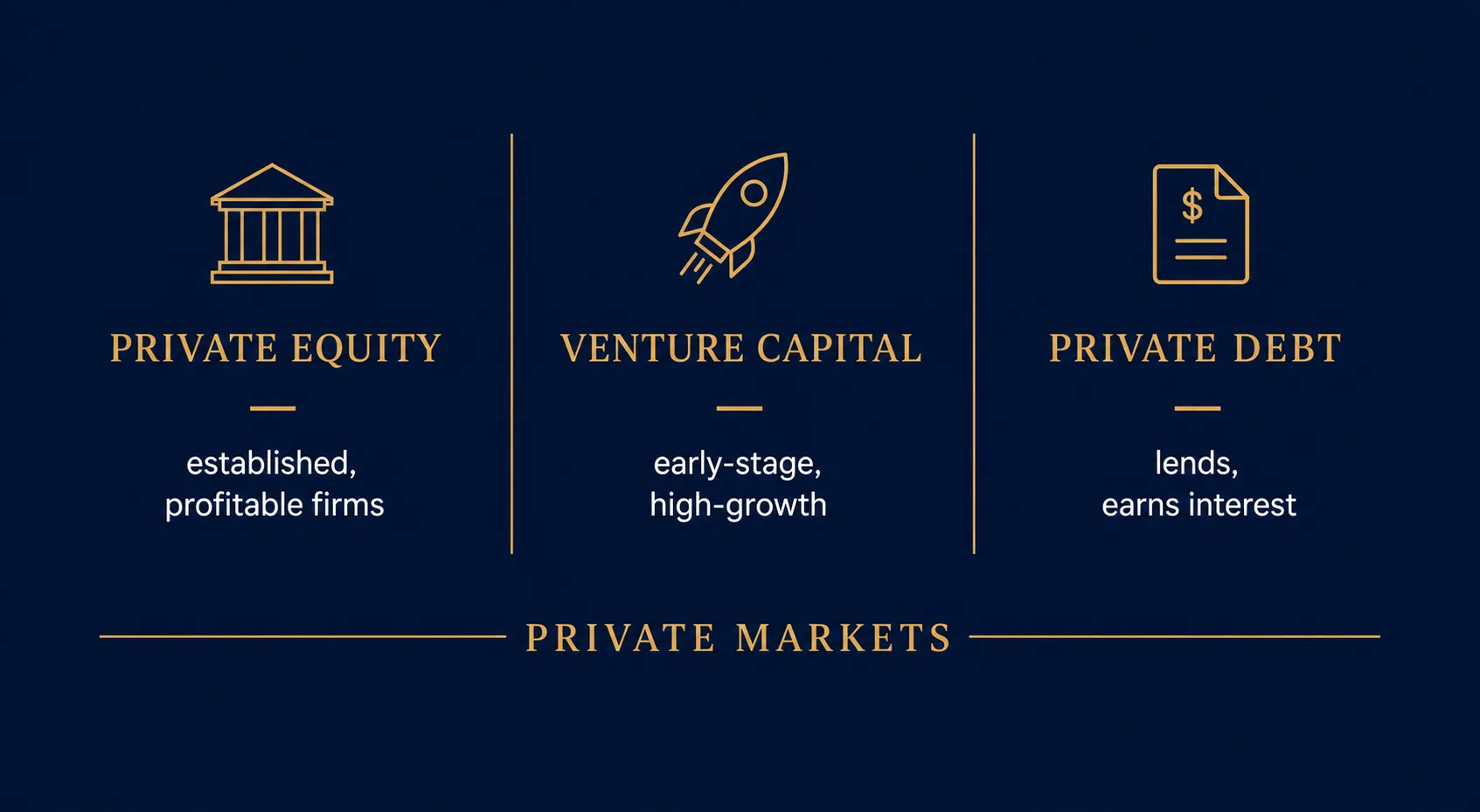
Private equity vs venture capital vs private debt
The terms overlap but are not identical.
| Type | What it means |
|---|---|
| Private equity | Usually means buying established, profitable companies. |
| Venture capital | Backs earlier-stage, high-growth businesses that are often loss-making but scaling fast. |
| Private debt | Lends to private companies rather than taking equity, earning interest instead of ownership. |
All three sit under the wider “private markets” label, and knowing which one a UK route gives you exposure to is the first step in choosing how to invest.
Why investors look to private markets
The appeal is access to company growth that happens before an IPO, plus a potential illiquidity premium: because your money is locked away, you expect to be paid more for the inconvenience. UK pension schemes have moved into this space too, and The Pensions Regulator’s guidance on private markets investment sets out how trustees weigh those return prospects against the higher risk and reduced liquidity. Individual investors face the same trade-off on a smaller scale.
Do you qualify? Investor categories in the UK

This is the single biggest practical gate, and it answers the common question of how to invest in private equity as an individual in the UK. Many private deals are only marketed to certain categories of investor.
Retail, high-net-worth and sophisticated investors
Broadly, UK rules recognise everyday retail investors, high-net-worth individuals (typically those with income above a set threshold or significant net assets), and self-certified sophisticated investors (people who can show relevant experience, such as being a company director or an existing angel investor). The high-net-worth and sophisticated categories can access deals that are off-limits to ordinary retail investors, but they must confirm their status in writing before investing.
What FCA rules mean for access
Financial promotion rules restrict how unlisted, higher-risk investments can be advertised, which is why direct private deals often ask you to certify your category first. The UK remains one of the more open developed markets for this kind of activity, and the US State Department’s 2024 Investment Climate Statement for the United Kingdom describes a broadly welcoming environment for private and foreign capital, supported by a mature regulatory framework. That openness does not remove the investor-category checks; it sits alongside them.
The UK is launching a private stock market. HNWIs will be able to trade private company shares on a new standardized platform, called PISCES ( …Read on LinkedIn ↗
Six ways to invest in private companies in the UK

1. Listed private equity investment trusts
The most accessible route. These are companies quoted on the London Stock Exchange that invest in portfolios of private businesses. You buy their shares through any normal brokerage or ISA, get daily liquidity, and gain diversified exposure to private markets without needing sophisticated-investor status.
2. Private equity ETFs
An exchange-traded fund that tracks an index of listed private equity firms gives you low-cost, diversified exposure in a single trade. You are investing in the managers rather than the underlying private companies directly, but it is one of the simplest ways in for beginners.
3. Funds of funds
A fund of funds is a single investment that spreads your money across several underlying private equity and venture capital funds, so one commitment gives you a stake in dozens of private companies. For UK individuals who want private-market access without picking deals themselves, it is often the cleanest route to institutional-quality exposure with diversification built in, though minimums tend to be higher and the fees are layered.
4. Direct and deal-by-deal investing
Some platforms offer access to individual private companies on a deal-by-deal basis, letting you choose your own deals and set your commitment. This gives control and concentrated upside, but demands more diligence and usually requires you to certify as a high-net-worth or sophisticated investor.
5. Angel investing and equity crowdfunding
Angel investing lets you put money straight into an early-stage UK company, often alongside other angels in a syndicate that pools capital and diligence. Equity crowdfunding platforms open the same idea to smaller investors, sometimes from a few hundred pounds, so you can take a small direct stake in a single startup. Both routes buy shares in the private company itself, which means they sit at the higher-risk, longer-hold end of the options here.
6. EIS, SEIS and VCTs
The Enterprise Investment Scheme, Seed Enterprise Investment Scheme and Venture Capital Trusts are tax-advantaged routes designed to channel money into smaller, higher-risk UK companies. They can offer income tax relief and capital gains advantages in exchange for holding the investment for a set period. A common follow-up is which scheme suits your situation better, and we answer that in a dedicated side-by-side comparison. Our guide to SEIS vs EIS walks through which of these two a business can actually qualify for, and at what stage of its life. These schemes are part of a wider effort to back UK innovation, and the government’s work on private sector R&D investment policies explains why supporting investment in early-stage, research-intensive companies is a policy priority. Always check current eligibility and reliefs before committing.
How to invest in private companies with little money

You do not need to be wealthy to start investing in private companies. Listed private equity investment trusts and PE ETFs give you exposure to a portfolio of private businesses for the price of a single share, sometimes under £100, through a standard brokerage account. Equity crowdfunding platforms let you back an individual private company from as little as the low hundreds.
Whichever of these low-cost routes you use, holding the shares inside an ISA or SIPP shelters your returns from certain taxes, which matters because private-company investments are meant to be held for many years. The realistic caveat: direct deals and fund-of-funds routes usually start at £10,000 or more, and some run far higher, so if your budget is small the listed and crowdfunding routes are the ones actually open to you.
Private money is not emergency money.
How to invest in private companies as a beginner: a step-by-step approach
1. Define your goal, timeframe and how much you can lock away. Assume it is tied up for five to ten years or longer. 2. Confirm your investor status. Decide whether you are investing as a retail, high-net-worth or sophisticated investor, as this determines which routes are open. 3. Choose your access route. Match the method to your risk appetite: a listed trust or ETF for a gentle start, direct or angel investing for concentrated risk. 4. Do your diligence. Research the manager’s track record, the platform’s regulation, or the individual company’s finances and team before committing. 5. Size the position and diversify. Keep private holdings to a sensible slice of your overall portfolio and spread across several investments rather than one bet.
Understand the risks before you commit
Investing in private companies carries real risks that public shares do not, and they shape which route makes sense for you.
Illiquidity and lock-ups. Unlike listed shares, a stake in a private company usually cannot be sold when you want. Your capital can be committed for years, and there may be no buyer when you finally want to exit, so whichever route you choose, only invest money you will not need within that window.
Valuation opacity and capital loss. Private companies are not priced daily, so valuations can be stale or optimistic, and many early-stage businesses fail entirely, meaning you can lose your whole stake. UK business investment shifts with the economic cycle, and the Office for National Statistics guidance on measuring business investment in the UK shows how carefully these figures have to be tracked, a reminder that private markets move with conditions outside any single company’s control.
Fees, capital calls and concentration. The route you pick carries its own cost risk: layered fees on funds and fund-of-funds routes can erode returns, some private equity funds issue capital calls that require further payments on demand, and putting too much into one private deal amplifies loss. Spreading your money across several holdings is the main defence.
What about the “how to invest in private companies UK reddit” advice?
Forum threads can be a useful reality check on how people actually access private companies in the UK. The recurring takeaways tend to be sensible: a fund of funds is the practical access route for most individuals, self-certify your investor status honestly rather than to unlock deals you should not touch, and expect genuine illiquidity. Treat that as a starting point, not gospel. Anonymous forum posts are not regulated financial advice, and the person recommending a deal rarely knows your full circumstances.
Frequently asked questions
How do I invest in private equity as an individual in the UK?
Can beginners invest in private companies in the UK?
How much money do I need to start?
What is the difference between private equity and venture capital?
Are private company investments tax-efficient in the UK?
Which route into private companies is right for you depends on your investor status, your capital and how long you can stay invested. Start with the accessible listed options if you are new, reserve direct and angel deals for money you can afford to lose, and treat diligence and diversification as non-negotiable. For higher-commitment routes, it is worth seeking suitability guidance so the investment genuinely fits your circumstances.